Church in a Saloon
In the summer of 1879, Tombstone had no permanent buildings at all. There was no church, no school, no town government, not even a justice of the peace or a constable. What it had was Sam Danner's saloon, a fifty-foot tent with a dirt floor, kerosene lamps hanging from the ridge pole, and a bar made of planks laid across empty whiskey barrels. Every drink cost the same two bits, and nearly every drink was straight whiskey. Miners, cowboys, and men of less certain occupation all passed through, and for a while Danner's tent was the closest thing the camp had to a town square.
David Chamberlain, who arrived that year with less than five dollars in his pocket and made his first stake digging wells and selling water at a dollar and a half a barrel, left the best account of the place. His most memorable story concerns Tombstone's first religious service. Danner's two bartenders, both raised in devout Methodist families, posted a notice that a class and prayer meeting would be held the following Saturday night from nine until ten o'clock, with the bar closed for the hour. Admission was by ticket only. The tickets were old playing cards stamped with Danner's initials, handed out by a man sitting on a soap box outside, and each one was good for a free drink of whiskey once the meeting was over.
The meeting was well attended. Danner opened it with a prayer that could only have come from a saloon keeper:
Oh Lord, we pray for full forgiveness of all the sins we have committed, but what we most repent of is for those we have omitted.
Sam Danner, as remembered by David ChamberlainThe congregation sat on bags of flour or stood. A banjo player named Wash Harris led the singing. Danner then invited each man to confess the sins of his boyhood, and the confessions ran to stolen watermelons and Halloween pranks. Every man present, Chamberlain noted, swore he had been raised by a good Christian mother. When Chamberlain suggested to Danner that the whole thing might be carrying a joke too far, Danner replied that it could not offend the ladies, because there were none present, and it could not set a bad example for the children, for the same reason. After the benediction, the congregation lined up at the bar, turned in their playing cards, and had their whiskey. No one got drunk, Chamberlain insisted, and no one swore. "They were all far away from civilizing influences, every man for himself, and as a whole not a bad lot," he wrote. "Surely they were charitable, always saw that no one went hungry, and if they were sick or in distress there were always friends to take care of them."
Chamberlain wrote his memoir many years later, after he had become a wealthy drug manufacturer in Des Moines, and a story this good has probably been polished in the retelling. But his picture of the camp, all men and no institutions, matches everything else known about Tombstone in 1879.
An Air of Domesticity
That picture did not last long. Clara Spalding Brown, who wrote regular letters from Tombstone to the San Diego Daily Union, described the change in August 1880: "A year ago the advent of a woman was quite an interesting event, when the female population was so small that it was easily counted, but families have been coming in every week since then, until now there is quite an air of domesticity pervading the camp."
The census numbers tell a more measured version of the same story. The 1880 federal census found a young, mostly male, and largely unattached population: the average resident was thirty-one, half were single, only thirteen percent were married couples living together, and only about one resident in eight was under seventeen. Two years later, a county census taken in July 1882 counted 5,300 people in Tombstone from twenty-four different countries, including 559 Irish, 423 Mexicans, 300 Germans, 245 Chinese, and roughly 200 each from Canada and Great Britain. The Epitaph, studying the results, pointed out something that cut against the town's polyglot reputation: only 1,246 of those residents spoke a mother tongue other than English. (The paper also insisted that the real population was "fully 7,000." For more on how slippery Tombstone's population figures can be, see What Was the Population of Tombstone?)
Families brought churches, schools, and above all a social calendar. By July 1882 the town had seven congregations, and the evenings were filling up fast.
If You Go, You Must Dress Up
Tombstone's residents formed clubs the way later generations would form committees. The Tombstone Social Club, made up of businessmen and professionals, set the tone with an invitation-only first event and a blunt rule printed on the invitation: "If you go, you must dress up." Clothing merchants answered with advertisements for white shirts, new-style ties, and the best dancing shoes. The same club also held a "calico" dance on Thanksgiving Eve where casual dress was permitted, a reminder that even a dress code needed a night off.
At the top of the social ladder sat the Tombstone Club, limited to forty charter members, which occupied the entire top floor of the Grand Hotel. Its rooms held a reading room stocked with newspapers and magazines, a chess table, a card room, and a billiard table worth a thousand dollars. The club was formally organized in the hotel's parlors on March 4, 1882, and its membership roll shows how small the town's upper tier really was: Sheriff John Behan and Dr. George Goodfellow both appear among the founding members, at a moment when the town was still deeply divided over the gunfight that had pitted Behan against the Earps.
Below that rarefied level, the variety was remarkable. The Tombstone Literary and Debating Club met for its members' "benefit, instruction, and pleasure" and argued over whether women had more influence over men than money did, whether a funeral could be considered entertainment, and whether single or married women made better schoolteachers. The young members of the Magazine Club pooled their subscriptions and traded the leading magazines of the day. Tobacconist Joseph Goldtree set aside a corner of his Allen Street shop for 250 books and advertised it as a free library. A Spanish class enrolled seventeen students, with an advanced class to follow. The Lawn Tennis Club played on Fremont Street. The Glee Club rehearsed on weeknights at, of all places, the Oriental Saloon.
Tombstone even had a scientific society, which met in Dr. Goodfellow's medical office. In March 1882 Goodfellow, Professor John A. Church, and eight other men held a preliminary meeting "and resolved to organize a microscopical society," appointing a committee to find a site for a building of its own. A camp that had held its first worship service in a saloon tent less than three years earlier now had men planning a building for looking through microscopes.
Competition among all these groups could get testy. When someone announced a "Big Four Masquerade Party," the members of the existing Big Four Club protested publicly that they had nothing to do with it. The newcomers settled the dispute by renaming themselves the "Big 4 Big Club" and charging five dollars a couple for their masquerade.
Alongside the social clubs stood the fraternal orders: the Masons, the Odd Fellows, the Knights of Pythias, the Good Templars, the Ancient Order of United Workmen, the Grand Army of the Republic, veterans of the Mexican War, and the Irish Land League. The German Turnverein, organized by thirty-five men in September 1880, built a hall with gymnastics equipment and eventually opened its membership to men of other backgrounds.
A Dancing Town
If Tombstone had a favorite pastime, it was dancing. By 1882 the town supported twelve musical groups, among them the eleven-piece Tombstone Silver Cornet Band, a brass band that practiced nightly, an Italian string band, and Mendel Meyer's orchestra of two violins, a cornet, and a piano, which played all night at dances. Three dance academies taught the steps. The quadrille, a forerunner of the square dance, ruled the floor, alongside the schottische, the mazurka, the polka, and the waltz.
Even reluctant dancers got swept up. George Parsons, not usually one for the ballroom, went to watch a costumed minuet at the Grand Hotel on Washington's Birthday in 1881 and found himself trapped. "Mrs. M got a dance out of me by requesting me to hold her fan," he wrote in his diary that night. "My first and only dance since leaving San Francisco."
Private celebrations followed the same pattern. In early 1882 the Epitaph reported a whole run of themed wedding-anniversary parties. Mr. and Mrs. Chas. Glover marked their first anniversary with a "Cotton Wedding," where the decorations and even the guests' clothing were made of cotton. Mr. and Mrs. T. E. Sumner's friends "invaded" their home for a twenty-fifth "Silver Wedding." For Mr. and Mrs. J. A. Kelly's "Wooden Wedding," the house was hung with festoons of evergreen and lit by a "galaxy of Chinese lanterns," and the dancing went on late into the night.
The most inventive party of the season may have been the farewell held in March 1882 for two departing mining men, Chris Batterman and M. A. Elliott, who were leaving for San Francisco. Their friends threw it inside the hoisting works of the Head Center mine. The Epitaph described what they did with the space:
A space in the hoisting works between the engine and main shaft had been cleared and tastefully decorated with flags and bunting. The floor was smoothed and well waxed... improvising a novel but no less pleasant ball room.
Weekly Epitaph, March 20, 1882The Italian string band played, the dancing continued past midnight, and supper was served at twelve. The paper called it "one of the most successful social events that has ever occurred in this territory."
Amateurs on Stage
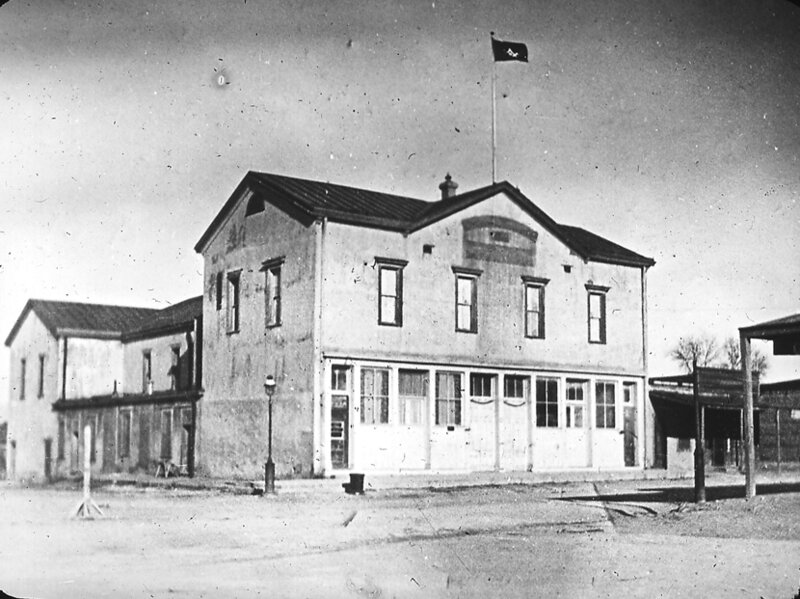
Tombstone drew professional touring companies, but much of its theater was homemade, and the town's critics did not go easy on their neighbors. When the Pinafore Troupe, made up of twenty local actors and thirty members of the Episcopal choir, first staged Gilbert and Sullivan's comic opera, one audience member called it "hideous with its blood-curdling discords." The troupe kept rehearsing and improved. By May 1882 the Epitaph was marveling at the hold the "genial absurdity" had on the public, noting that front seats were "eagerly sought" every time it came around again. Clara Spalding Brown, herself an amateur actress and a member of the Tombstone Dramatic Association, was more measured. She wanted her San Diego readers to understand that the Tombstone production "was by no means as good as the work of their amateurs," while allowing that it had been "difficult to prepare such a piece in this place." (Her full story is told in Clara Spalding Brown: Tombstone Through a Woman's Eyes.)
The audiences drew complaints of their own. At one winter performance in Schieffelin Hall, a reporter observed that nearly every man in the room was smoking, filling the poorly ventilated hall with clouds of cigar smoke, and scolded that "gentlemen would not blow clouds of smoke into rooms filled with women... That smacked of ill-breeding." The ventilation was apparently fixed in short order, because patrons at later winter events complained instead of a bone-chilling draft that swept the hall whenever the stage curtains opened. Another Epitaph writer, distracted by restless children during a lecture, asked why parents insisted on bringing them at all, since "the little ones always commence to squall at the wrong time."
Contests of Every Kind
Tombstone's sporting life ranged well beyond the saloon card table. The town had a horse-racing season, with a track north of town toward Watervale and another at Doling's driving park on the old Contention road. It had shooting galleries, where tournament scores were printed in the newspapers, and a bowling alley at the Tivoli Saloon, six frames for twelve and a half cents. In January 1882 it fielded its first organized baseball teams.
Some contests were more surprising. Competitive walking was one of the great spectator sports of the nineteenth century, and on Christmas night of 1881 a woman billed as Madam Du Pree set out from Tombstone at 8:30 p.m. against three male challengers in a six-day distance match for a four-hundred-dollar prize. According to the Nugget, she had been an invalid only a few years earlier. When the six days were up, she had covered 434 miles. The best of the three men managed 157.
Wrestling drew crowds too. Late in 1880 the internationally known wrestler Andre Christol offered to take on anyone in Tombstone, and a city policeman named James W. Bennett accepted, putting up five hundred dollars of his own. The match, billed as "The Great Wrestling Match" and the "Event of the Season," was fought in three styles before a large crowd at the Sixth Street Dance House. Bennett, at six feet and two hundred pounds, had forty pounds on the visitor. Christol took the first round, but Bennett threw him in the next two and the referees awarded the policeman the match over Christol's protests.
Fifty Cents for Dinner
Tombstone ate well. The town had at least fifty-five restaurants by 1882, and some of them would not have embarrassed San Francisco. The Occidental Restaurant advertised a Sunday dinner, for fifty cents, that ran through soups, salmon, leg of lamb with oyster sauce, a selection of roasts, pastries, and English plum pudding. The Grand Hotel's restaurant offered six private dining rooms for gentlemen and their companions, and residents with a sweet tooth could choose among the town's ice cream parlors.
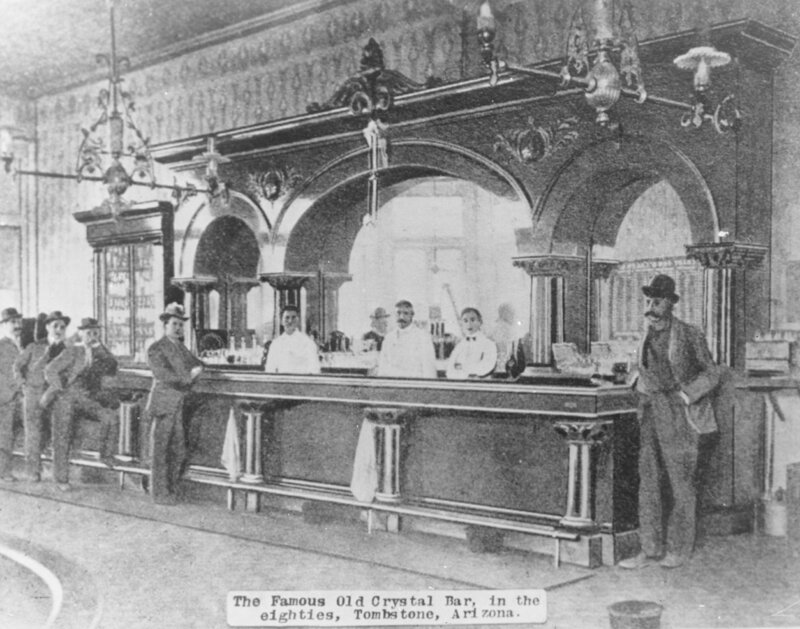
The saloons, of course, were everywhere, more than seventy of them by the newspapers' count. Yet one historian who studied the 1880 census and the town's records found that Tombstone's saloons per resident were roughly the same as New York City's and fewer than San Francisco's. The saloons competed hard for business. The Bonanza offered twelve-and-a-half-cent drinks and a daily free lunch, an early version of happy hour, and the free lunch counters across town were stocked with bologna, liverwurst, anchovies, pickles, pig's snout, corned beef, and cheese, all heavily salted to keep customers thirsty. The Alhambra advertised poker jackpots as high as four thousand dollars and hired nightly piano players. (For the game that kept the gambling rooms busy, see Faro.)
The finest of them all was the Oriental, which Clara Spalding Brown described shortly after it opened in July 1880 as "gorgeous" and "the finest place of the kind this side of San Francisco," with a bar originally built for San Francisco's Baldwin Hotel and music from a piano and violin every evening. But she added a pointed observation. The scene was "really a gay one," she wrote, "but all for the men." The Oriental held dances that some people called "respectable," but as long as so many women of the demimonde attended them, she explained, many honest women would stay away. Much of Tombstone's social life, in other words, divided along lines that everyone understood, even when no one wrote them down. (Many of the women on the other side of those lines ran businesses of their own; see Ladies of Enterprise: The Businesswomen of Tombstone.)
Hurrah for Tombstone
By 1882, the newspapers could count fourteen social clubs, eleven social fraternities, twelve musical groups, three dance academies, ten organized sporting activities, eight newspapers, seven churches, a public school and a private one, a hospital, and two libraries. Which brings us back to that "quiet week" in December 1881. The Epitaph's editor was boasting, of course, but he was not inventing anything:
It is safe to say that no other town in the United States, of its size and population, is supplied in the way of amusements than Tombstone. Only last week, which was a quiet week, there were meetings of firemen, the Odd Fellows, City Council, and the Literary and Debating society, together with a ball, a theater, a dancing school, and couple of private parties. Hurrah for Tombstone!
Tombstone Epitaph, December 1881, as quoted by Lonnie UnderhillThat boast was printed while the Earp-Cowboy feud was still very much alive; before the month was out, Virgil Earp was ambushed and badly wounded on Allen Street. Both things were true at once. Tombstone was the town of the gunfight, and it was also a town where most people spent their evenings at lodge meetings, dancing lessons, debates, and anniversary parties, and where the biggest controversy of a given week might be whose club got to call itself the Big Four.
Nor did that social life vanish when the boom slowed. In February 1886, with the mines already struggling against rising water and falling silver prices, Parsons helped stage an amateur production of Esmeralda before an audience of 311 people, shaving his beard to a goatee between acts so he could play two different characters. "Possibly the best amateur performance," he wrote the next day. "Certainly one of the best ever given on the Coast. Our talent here is quite remarkable." The camp that had once held its only church service in a saloon tent had become, in every way that mattered to the people living there, a home.
Sources
- Underhill, Lonnie E. "'If You Go, You Must Dress Up': Social Life in a Frontier Mining Town, Tombstone, Arizona, 1879-1882." Journal of Arizona History, vol. 57, no. 3, 2016, pp. 281-312. [Primary secondary source for the social clubs, the Literary and Debating Club, the Pinafore Troupe, theater audiences, music, sports, dining, saloons, the 1882 inventory of amenities, and the December 1881 Epitaph quotation.]
- Chamberlain, David. "Tombstone in 1879: The Lighter Side." Journal of Arizona History, vol. 13, no. 4, 1972, pp. 229-234. [Eyewitness memoir source for Sam Danner's tent saloon and the first religious service in Tombstone.]
- Brown, Clara Spalding. Correspondence to the San Diego Daily Union, July 1880 to November 1882. [Source for the descriptions of the Oriental Saloon, the arrival of families, and the July 1882 Pinafore review.]
- Parsons, George Whitwell. The Private Journal of George Whitwell Parsons, Volumes I and II. Edited by Carl Chafin. Cochise Classics. [Source for the February 22, 1881 minuet and the February 1886 Esmeralda performance.]
- Hershey, Dorothy Virginia. "A Study of Lawlessness and Irrational Violence in the Urban Frontier Community of Tombstone, Arizona, circa 1879." The Cochise Quarterly, vol. 26, no. 3, 1996. [Source for the 1880 census household statistics and the per-capita saloon comparison with New York and San Francisco.]
- Monahan, Sherry A. Tombstone's Treasure: Silver Mines and Golden Saloons. University of New Mexico Press, 2007. [Source for the July 1882 county census figures by nationality.]
- Arizona Memory Project, Arizona State Library, Archives and Public Records. [Source for the photographs of Schieffelin Hall (1915) and the Crystal Bar.]
- Weekly Epitaph, January 23, 1882 (Cotton and Silver Weddings); February 20, 1882 (Wooden Wedding); March 13, 1882 (organization of the Tombstone Club); March 20, 1882 (the microscopical society and the Head Center farewell party); May 20, 1882 (Pinafore review); July 8 and July 15, 1882 (county census results). [Primary sources, transcribed from the original page images in the Tombstone Silver research archive.]