
Newspaper Accounts
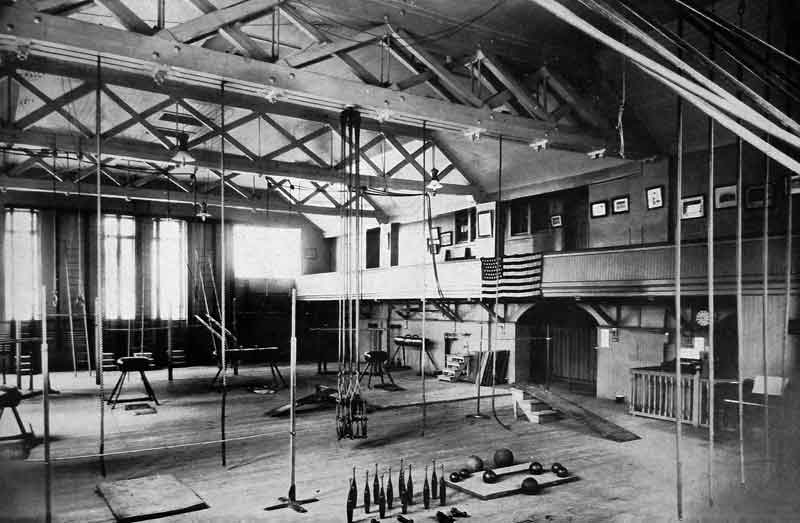
Tombstone’s Turnverein Hall was an important location for meetings and social events. While it is not possible to know how many people could fit in the hall, it is reasonable to assume that it would accommodate a crowd of about 150. Thus, Schieffelin Hall would be used for events of up to 500, and the Turnverein Hall, just one block away, would be used for smaller events. The following articles were found in the Epitaph Newspaper and illustrate the types of events that would have been hosted at the Turnverein Hall.
The Turnverein was just one piece of a remarkably rich civic and social fabric. By 1882, Tombstone supported 14 social clubs, 11 fraternal orders, 3 dance academies, and 12 musical groups, along with a Microscopic Society, a Scientific Society, a Lawn Tennis Club, a Literary and Debating Club, and a Magazine Club. The Tombstone Silver Coronet Band performed Christmas carols at Turnverein Hall that year. The editor of the Tombstone Epitaph captured the mood well in December 1881: "It is safe to say that no other town in the United States, of its size and population, is supplied in the way of amusements than Tombstone."
Years later, looking back on the town he had known, Principal Sherman offered his own assessment: "Outstanding in my mind is the fact that there were more people in the hey-day of Tombstone, ranking high in education, in culture, in genuine accomplishment, than could then or even now be gathered in a city of ten times its population."
The dancing academy of Mesers. McCarty & Stewart has been continuing its lessons in the giddy art without an intermission from the start, some six weeks ago, and pupils who at that time found it difficult to catch the simplest step now pass through the dance with ease and grace. The class, which numbers about thirty members, meets every Wednesday and Saturday evenings at Turn Verein hall, where they receive instructions from the professors. Mr. McCarthy's method of teaching is so simple that it requires but a short time to become something of a dancer. Young ladies generally attend the class, and thus the lessons pass off very pleasantly.
Tombstone Epitaph, April 24, 1882, Page 5 (https://www.loc.gov/resource/sn84021939/1882-04-24/ed-1/?sp=5)The dance at the Turn Verein Hall tonight will be a grand affair and opening of the season. Over 100 tickets have already been sold and the committee expects to largely increase the number today.
Tombstone Epitaph, September 5, 1889, Page 3 (https://www.loc.gov/resource/sn96060681/1889-09-05/ed-1/?sp=3)[This short article was part of a report about the 4th of July activities that included "delegations from Tucson and Phenix."] This evening a reception will be given to the Tucson people and invited guests at Turn Verein Hall. The reception will commence at 7:30, and will consist of skating for about two hours, followed by dancing.
Tombstone Epitaph, July 5, 1890, Page 3 (https://www.loc.gov/resource/sn95060905/1890-07-05/ed-1/?sp=3)Sources
- Lonnie E. Underhill, “If You Go, You Must Dress Up,” Journal of Arizona History, vol. 57, no. 3 (2016).
- Herbert Love, History of Tombstone to 1887 (1933).
- Matia McClelland Burk, “The Beginnings of the Tombstone School, 1879–1893,” Arizona and the West, vol. 1, no. 3 (1959).
Location
The Turnverein Hall was located at the southeast corner of 4th and Safford Streets. That location is a private residence today and there is nothing remaining of the Hall.