
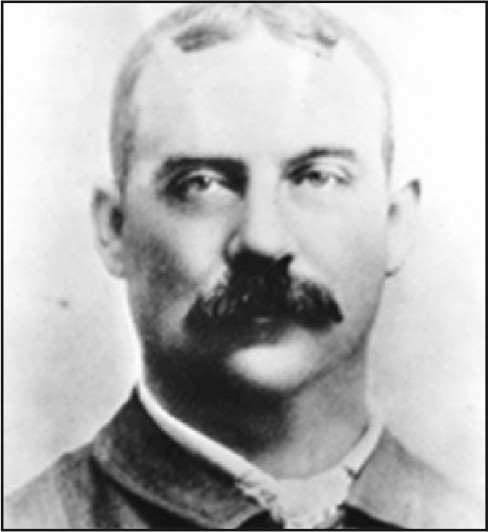
An Unlikely Path to Medicine
George Goodfellow was born December 23, 1855, in Downieville, California. His father Milton was both a mining engineer and a physician, and George grew up exposed to both professions. He was an able student and in 1872 received a coveted appointment to the U.S. Naval Academy at Annapolis. He arrived popular and athletic, winning the school boxing championship shortly after enrollment. His naval career ended within months: he was expelled in December 1872 for his role in a hazing incident involving the school's first African American cadet, John Henry Conyers.
Ashamed to go home, Goodfellow moved in with a cousin who practiced medicine in Meadville, Pennsylvania. His cousin's medical books proved more compelling than anything at Annapolis. He enrolled at the University of Wooster's medical department in Cleveland, graduating in February 1876. Later that year he married Katherine Colt, who happened to be a relation of Samuel Colt, inventor of the revolver that would figure so prominently in his future practice.
Private practice in Oakland failed to hold his attention. He moved to Prescott, Arizona, to work alongside his father as a mine surgeon, then accepted an appointment as assistant military surgeon at Fort Whipple and later Fort Lowell in Tucson. In September 1880, aged 25, he arrived in Tombstone.
Practice at the Crystal Palace
Tombstone in 1880 had roughly 2,000 residents and twelve physicians. Goodfellow opened his practice on the second floor of the Crystal Palace Saloon on Allen Street. He quickly became friends with Wyatt, Morgan, and Virgil Earp and Doc Holliday, and his association with the Earp faction was well known. It made no difference to his practice. He treated injured Cowboys without asking questions, and sometimes without even learning their names. As historian Ben T. Traywick put it: "Goodfellow never asked questions, not even the name of his patient. His interest was solely in saving lives."
He also served intermittently as Tombstone's town coroner, a role that gave him firsthand familiarity with the mechanics of gunshot wounds from both the surgical and forensic directions. Tombstone in those years provided ample material for both.
That curiosity extended beyond the operating table. When Luke Short shot Charlie Storms through the heart at the Oriental Saloon in February 1881, Goodfellow retrieved the bullet afterward and brought it to George Parsons’ room, showing him the flattened .45-caliber round and the bloody handkerchief that had been carried into the wound. His forensic interest was never merely clinical.
In June 1881, Parsons was badly injured in the fire that burned much of Tombstone's business district, a roof collapsing on him while he was fighting the blaze. Goodfellow cleaned the wounds, cut away ragged edges, pulled out splinters, and put in some thirty stitches, washing everything with carbolic acid throughout. Parsons recalled that Goodfellow “certainly made a very neat job.” He never charged Parsons for the work.
The O.K. Corral and Its Aftermath
On October 26, 1881, the gunfight at the O.K. Corral lasted perhaps thirty seconds and left three men dead and two wounded. Goodfellow was on the scene quickly. He tended to the Earp brothers and Doc Holliday, then performed the autopsies on Billy Clanton, Frank McLaury, and Tom McLaury, the three Cowboys killed in the fight. His autopsy reports are among the most detailed forensic records of the event.
The aftermath proved more demanding. In December 1881, Virgil Earp was ambushed on Allen Street; a shotgun blast shattered his left arm. By chance, Goodfellow had been visiting George Parsons just across the street moments before the shots rang out, and he was among the first to reach Virgil. He operated, removing four inches of the humerus bone. The operation saved the arm. Virgil retained use of it for the rest of his life, though it never fully recovered.
Morgan Earp was shot in March 1882, killed by a bullet fired through the rear window of Hatch's Saloon. Goodfellow could do nothing for him. Morgan was shot through the spine; he died on the billiard table within the hour.
The First Abdominal Surgery for a Gunshot Wound
The standard nineteenth-century treatment for an abdominal gunshot wound was to probe the entry wound, attempt to locate and remove the bullet, and wait. Most patients died. The abdomen was considered inoperable territory, not because surgeons lacked skill, but because the medical consensus held that opening the abdominal cavity invited fatal infection. Goodfellow disagreed, and he said so in print:
The .44 or .45-caliber Colt revolver... are the toys with which our festive and obstreperous citizens delight themselves... Their maxim is "shoot for the guts," knowing that death is certain, yet sufficiently lingering and agonizing to afford a plenary sense of gratification to the victor.
Dr. George Goodfellow, "Cases of Gunshot Wound of the Abdomen Treated by Operation," Southern California Practitioner, May 1889.On July 4, 1881, a 47-year-old man named Jack Smith was shot in the abdomen with a .32-caliber Colt. He was brought to Goodfellow five days later. Goodfellow monitored him for four more days, watching his condition worsen steadily. On July 13, he operated: a four-inch incision, repair of six separate bowel injuries, drainage of purulent collections, irrigation of the abdominal cavity, and closure. Smith was discharged one month later. The bullet was never found.
The key to the operation's success was Goodfellow's use of Joseph Lister's antiseptic technique throughout: sterilized hands, sterilized instruments, a sterilized operative field. Listerism was not yet standard practice in American surgery, particularly not in the frontier West. His assistants were hardened miners. His anesthesiologists were barbers. He published this case and four similar ones in 1889, identified the procedure as "the first operation of the kind," and declared that failing to operate on such a patient was "inexcusable and criminal." Medical historians regard him as the first American civilian trauma surgeon.
Silk, Cocaine, and the Prostate
Goodfellow's medical curiosity extended in several directions at once. In 1887 he published "Notes on the Impenetrability of Silk to Bullets" in the Southern California Practitioner, describing three cases in which silk handkerchiefs had not been penetrated by bullets or buckshot. The U.S. military later explored silk body armor as a direct result of his observations.
He also experimented with dissolving cocaine in patients' spinal fluid to improve surgical anesthesia. He abandoned the approach when patients began dying "in strange and devious ways." The notation is characteristic: precise about the outcome, tactfully vague about the details.
In 1891, at St. Mary's Hospital in Tucson, he performed the first perineal prostatectomy for benign prostatic hyperplasia ever recorded in American medicine. He then traveled the country demonstrating the technique to colleagues, eventually performing it on 78 patients.
The Sonora Earthquake Survey
On May 3, 1887, a major earthquake struck northeastern Sonora, Mexico. Clarence E. Dutton, head of the U.S. Geological Survey, had no field personnel available. He knew Goodfellow personally and sent him a telegram commissioning an official USGS investigation. Goodfellow had just returned from Sonora after investigating a reported new volcano (which proved exaggerated). He agreed to go back.
In July 1887 he headed south with Mexican guides. At Bavispe he met José G. Aguilera, the Mexican government's investigator, and the two made independent parallel surveys of the damage zone. Goodfellow's problem was measuring the direction of the seismic vibrations without a proper seismograph. His solution: he suspended a bullet inside a large beer bottle, which gave him the direction of vibrations with what he called "moderate accuracy."
On the west face of the Teras Mountains he found a fault scarp running more than 35 miles, with displacement reaching 11 feet at the northern end. He documented millions of cubic feet of rock thrown from the mountains into the canyons below and permanent changes to stream flow in the Yaqui and San Bernardino Valleys. Photographer C. S. Fly accompanied the expedition; Fly's images of fault lines, ruined buildings, and survivors illustrated the official report. Four photographs were reproduced as engravings in Frank Leslie's Illustrated Newspaper in March 1888. Goodfellow published his findings as "The Sonora Earthquake" in Science in 1888.
Later Career
Goodfellow left Tombstone around 1891 as the mining boom wound down. He was appointed district railroad surgeon for the Southern Pacific, replacing his friend Dr. J. C. Handy of Phoenix after Handy died from a gunshot wound. The appointment illustrated his reputation: when Handy was shot, Goodfellow received a telegram in Tombstone and reached Phoenix in four hours, traveling by horse to Fairbank, then narrow-gauge rail to Benson, then locomotive to Phoenix, with the Southern Pacific clearing the line ahead of him. Handy did not survive, but the railroad's response to Goodfellow's need for speed said everything about his standing with them.
In 1898 he volunteered for service in the Spanish-American War and was present at the surrender following the Battle of San Juan Hill, where he served as translator and provided the alcohol used in the ceremony.
After the war Goodfellow settled in San Francisco, where his mother and sister still lived, and built a major practice, becoming a national authority on prostate surgery. That success crumbled with the 1906 San Francisco earthquake, a pointed irony for a man whose own most famous fieldwork had been surveying earthquake damage in Sonora two decades earlier. His final professional chapter took him back into Mexico: an old Arizona friend, Colonel Epes Randolph, by then head of the Southern Pacific's Mexican branch, appointed him leading surgeon for the line's expansion, with duties split between Guaymas and Tucson. While in Sonora, Goodfellow contracted an illness, probably beriberi, and was taken to Los Angeles for treatment by his brother-in-law, Dr. Charles W. Fish.
He died in Los Angeles on December 7, 1910, of multiple neuritis. He was 54 years old and was regarded at his death as one of the most skilled surgeons of his era. The frontier had been good for medicine, and Goodfellow had been good for the frontier.
Sources
- Duncan, Louis. "The Legacy of 'The Gunfighters' Surgeon.'" Trauma, vol. 17, no. 2 (2015). [Primary source for medical innovations, surgical cases, and career arc.]
- Bennett, James E. "An Afternoon of Terror: The Sonoran Earthquake of May 3, 1887." Arizona and the West, vol. 19, no. 2 (1977), pp. 107–120. [Source for earthquake commission details, beer-bottle seismograph, fault scarp measurements, and Aguilera collaboration.]
- Vaughan, Thomas. "C. S. Fly: Pioneer Photojournalist." Journal of Arizona History, vol. 30, no. 3 (1989). [Source for Fly's photographic documentation of the earthquake survey.]
- Ellis, Richard N. "Sheriff Jerome L. Ward and the Bisbee Massacre of 1883." Journal of Arizona History, vol. 35, no. 3 (1994). [Source for Goodfellow's role in the Heith inquest.]
- "Territorial Medicine." Cochise County Historical Journal, Spring/Summer 1998. [Source for the J. C. Handy emergency and railroad surgeon appointment.]
- Bailey, Lynn R., and Don Chaput. Cochise County Stalwarts: A Who's Who of the Territorial Years, Vol. 1, pp. 147–149. [Source for the post-war San Francisco practice, the Southern Pacific Mexican-branch posting under Col. Epes Randolph, and the final illness treated by his brother-in-law, Dr. Charles W. Fish.]