
Introduction
Tour guides in Tombstone like to tell guests how many people lived here in the 1880s; unfortunately, guides have reported wildly different numbers, some as few as 3000 while others report 20,000 or more. One enterprising tour guide claims more than 100,000 people lived here during Tombstone’s heyday.
This report intends to answer the question, “How many people lived in Tombstone?” The primary sources are official United States census records, the Arizona territorial census completed in 1882, and two scholarly analyses of period records.
U.S. Census
United States government conducts a census every 10 years in order to apportion seats in the House of Representatives. The following table presents the results of the census for several years.
Notes: For some reason, in 1900 Tombstone was the only city in Cochise County to submit census information. The number submitted, though, seems abnormally small so there was likely an error in the enumeration process. The word “Phenix” was spelled that way in the census bureau reports for 1880 and 1890.
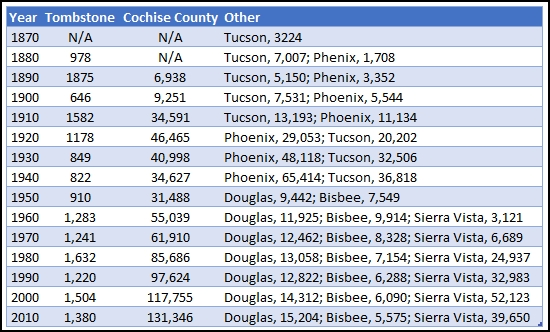
A note on the 1880 figure: Tombstone was counted across multiple enumeration districts, and different historians report different totals depending on which districts they include. A comprehensive tabulation gives 1,767 residents within Tombstone proper, drawn from at least 65 states and 27 countries. Cochise County as a whole recorded 4,758 residents. The average age in Tombstone was 31; roughly half of all residents were single; only about 12 percent were under age 17. This was a young, largely male, largely rootless population, a profile that explains both how the boom happened so fast and why the population fell away so sharply when the mines declined.
Territorial Census of 1882
In 1882 the territorial governor, Frederick Tritle, ordered a census to establish apportionments for the territorial "Council" (later named the Senate) and House of Representatives. The county board of supervisors appointed Billy Breakenridge the census marshal for Cochise County. The census results were discussed in the Epitaph newspaper in numerous articles over the summer and early fall of 1882.
On page 3 of the July 15, 1882, edition the Epitaph released the following counts for the largest communities in Cochise County: Tombstone, 5,300; Benson, 820; Contention, 452; Charleston, 423; Bisbee and vicinity, 410; Willcox, 324; Dos Cabozas, 245; Tres Alamas and Lower San Pedro, 298; St. Joseph, 212; Bowie and Tevis district, 125; All others combined, 1031.
Given the above, it seems that the population of Tombstone grew from 978 in 1880 to 5,300 in 1882 then shrank back to 1,875 in 1890. This growth pattern would not be unusual for a mining boom town.
In addition, on page 1 of the July 8th 1882 Epitaph, the following origins were reported from the 1882 census: Americans, 2,880; Irish, 559; Mexican, 423; German, 300; English, 279; Canadian, 254; and Chinese, 245, with smaller numbers from 16 other countries (including one from the Hawaiian Islands).
The 1882 count is consistent with a contemporary official estimate made just one year earlier. In 1881, Arizona’s report to the Territorial Legislature, Resources of Arizona, placed Tombstone’s population at 6,000 to 7,000. That figure, produced when the boom was at or near its peak, is roughly consistent with the 5,300 recorded by Breakenridge a year later, by which point two major fires (June 1881 and May 1882) and the first signs of mine flooding had already begun to thin the population.
1884 Cochise County Great Register
A third data point fills in the post-boom picture. The 1884 Cochise County Great Register was the official list of registered male voters. An analysis of that register found 1,386 registered voters in Tombstone out of 2,837 county-wide, meaning Tombstone still accounted for nearly half the county’s electorate two years after the boom peaked. Since the register excluded women, men under 21, and non-citizens, the actual 1884 population was considerably higher, probably in the range of 4,000 to 5,000. The town did not empty overnight. While the mining workforce dispersed quickly once operations curtailed, the courthouse, the county government, the legal profession, and the merchant class kept a substantial population in place well into the decline era.
Conclusion
Billy Breakenridge, the census marshal for Cochise County, was praised for his honesty and integrity, so his 1882 count can be trusted. Tombstone was a boomtown in the early 1880s, so there were likely 5,300 people living here in 1882, but that number had shrunk back to 1,875 by 1890 since the established mines began curtailing their operations and no new mines were opening. By 1890, those seeking easy wealth were moving on to new opportunities in places like Alaska, leaving Tombstone with a declining population. The census counts eventually bottomed out at 646 in 1900, before recovering somewhat to 822 by 1940. The following are reasonable conclusions from the numbers:
1. The maximum population was probably about 7,000, reached around 1881–82 at the height of the silver boom. The Resources of Arizona report of 1881 gave 6,000–7,000, and the 1882 territorial census recorded 5,300 (a figure likely reduced somewhat by the two major fires of that period and the first signs of mine flooding). It is unlikely that the population ever grew much larger than 7,000.
2. Everyone was counted. Some tour guides tell tourists something like "they did not count Mexicans" (or other groups). This statement is not valid. By federal policy, census enumerators (the people who collected data) were required to record the name, sex, and place of origin of every person living in each household in the area, so we know that everyone was counted.
3. Several cities in Arizona were larger than Tombstone. Some tour guides like to present Tombstone as the largest city between St. Louis and San Diego (or other pairs of cities), but this is not true. At the very least, Tombstone has never been more prominent than Tucson, not to mention places like Denver, so it is not accurate to say that Tombstone was the largest city anywhere outside of Cochise County. It may be true that Tombstone was the fastest growing city in the west for a brief period, perhaps 1879-1882, but it was never the largest city.
Sources
- U.S. Census Bureau, Decennial Census (1880 through 2010). Primary source for all federal census figures in the table above.
- Arizona Territorial Census (1882), as reported in the Tombstone Epitaph, July 8 and July 15, 1882. Source for Tombstone’s 1882 count of 5,300 and the national-origins breakdown.
- Resources of Arizona (1881), Report to the Arizona Territorial Legislature, University of Arizona Libraries. Source for the contemporary estimate of 6,000–7,000 residents at the boom’s peak.
- “An Analysis of the Great Register of Cochise County, Arizona Territory, 1884” (Crane 1988), The Cochise Quarterly, vol. 18, no. 1. Source for 1884 registered voter data and county-wide population distribution.
- “A Study of Lawlessness and Irrational Violence in the Urban Frontier Community of Tombstone, Arizona, circa 1879” (Hershey 1996), The Cochise Quarterly, vol. 26, no. 3. Source for the fuller 1880 census tabulation (1,767 residents in Tombstone proper), demographic breakdown (average age, marital status, age distribution), and county total of 4,758.