
A Brass Band on the Porch
Before Schieffelin Hall had a roof, it had music. The Tombstone Brass Band reportedly gave concerts on the porch while the building was still going up, which says a good deal about how the town thought of it. This was not just a building. It was an announcement that Tombstone intended to stay.
The builders were Al Schieffelin, the prospector whose strike started the town, and William A. Harwood, Tombstone's first mayor and a lumberman. The hall rose on the site of the Chiricahua (Morse) lumber yard and was finished in June 1881. The Tombstone Restoration Commission gives June 8 as the opening date and describes it as "the largest, most elaborate theatre between El Paso, Texas and San Francisco, California."

What They Built
The hall was a two-story adobe, 60 by 120 feet. Downstairs was an auditorium with a deep stage. The Restoration Commission counts 450 seats on the parquet floor and room for 125 more in the gallery, and says the drop curtain showed a Colorado landscape and "was considered a work of art." Upstairs were rooms rented to the Masons, Odd Fellows, Knights of Pythias, and Good Templars. The King Solomon Masonic Lodge has been headquartered in the building since it opened, and the Epitaph supports the early part of that claim. Reporting on Solomon Lodge's Washington's Birthday ball of February 22, 1882, the paper noted that "Schieffelin Hall was elegantly and tastefully decorated for the occasion."
It was not a perfect room. Audiences complained about cigar smoke, and in cold weather drafts swept across the auditorium whenever the stage curtains were drawn.
Opera, Pinafore, and Other Pleasures
The hall handled the respectable end of the entertainment business. Traveling theatrical companies and light opera troupes played here, while the Bird Cage Theatre handled variety acts. Admission ran about $1.50, which tended to keep the crowd well dressed. Early events included an Irish Land League ball in July 1881 and Tom Taylor's five-act play The Ticket-of-Leave Man that September. In February 1882 the hall was crowded for a fire department benefit, with the Wallace sisters' troupe making its farewell in Minnie's Luck and local volunteers closing the evening, for net receipts of $355.
Amateurs filled the stage as well. In November 1881 the correspondent Clara Spalding Brown, a founding member of the Tombstone Dramatic Association, appeared in the three-act drama Lost in London. The Daily Nugget said she "equalled some of the professionals who have visited this place." The Pinafore Troupe, about twenty actors joined by thirty members of the Episcopal choir, was at first panned for its "hideous blood-curdling discords," but it improved. By May 1882 the Epitaph was marveling at "what a hold that genial absurdity has on the public," and noting that front seats were eagerly sought whenever the evening came around again. (More on the town's theater and social calendar is in A Quiet Week in Tombstone.)
Not every night was a triumph. When the Nellie Boyd Troupe played the hall in September 1883, George Parsons went and recorded that the audience was too small for profit, so "money returned." And in April 1885 the town's amateurs, John Clum among them, staged The Toodles and the farce Turn 'Em Out to raise money for piping water to the new cemetery. Admission was a dollar, and reserved seats were sold at Sol Israel's.
Where Tombstone Argued With Itself
The hall was also the town's largest meeting room, and a boomtown has a great many meetings. On September 5, 1881, with fear of an Apache uprising running through the district after the fight at Cibecue Creek, the town gathered here. Parsons wrote that there was "much talk and little done," until the lawyer Tom Fitch restored confidence with a speech on what the scare would cost Tombstone if it got abroad. A benefit that same month raised money for a fire alarm bell, a practical lesson drawn from the June fire.
On the evening of April 8, 1882, General William Tecumseh Sherman was received at the hall. The Epitaph invited "all people of the community" to come and welcome him. Parsons found Sherman "much broken" and was disgusted by the "toadying," singling out Dibble and Clum. On July 4 the Independence Day program was held here, with Charley Pring at the organ and Miss Annie Brown singing "Columbia, the Gem of the Ocean." The Epitaph gave a poor review to Henry Dibble's oration, mocking its detour through the Bastille. In September the Republicans nominated their county ticket in the hall, and Jerome Ward won the sheriff's nomination over Thomas Atchison on a disputed recount. (See also the Fourth of July article.)
Politics here were not always dignified. In April 1886 Parsons attended an anti-Chinese meeting at the hall and wrote that he "heard some fellows make asses of themselves." He added: "I'm anti-Chinese, but in a practical way. Boycotting don't go with me and there is no reason for an anti-Chinese movement here." It is a mixed sentiment, but the entry shows the hall serving as the place where the town's worst impulses were aired in public, and sometimes talked down.
Two Nights, One Town
Some of the hall's most striking history comes from what happened around it. On the night of March 18, 1882, Morgan Earp and his brother Wyatt watched a performance of Stolen Kisses at Schieffelin Hall, then walked to Campbell and Hatch's saloon. Morgan was playing billiards when a shot came through the glass of the back door.
Parsons's entry for February 21, 1884 reads almost as eerily. He records a dress rehearsal at the hall, the arrival of an Episcopal bishop the next day, and his own confirmation arranged for the following Sunday. Then he adds that he and a friend, over hot Scotch, "rather think there'll be a necktie party tonight." There was: the lynching of John Heith.
The Best Amateur Performance on the Coast
By 1886 the boom was a memory, and the stage belonged to local talent. On February 18 Parsons helped stage the play Esmeralda. He wrote of "a tremendous house," which the edited journal counts at 311 people, "finest Tombstone ever saw." He played two parts, George Drew and the Marquis, and shaved down to a goatee between acts to change characters. The benefit cleared $155.50 at fifty cents a head, and a dance followed. The next day he called it "possibly the best amateur performance," adding, "Our talent here is quite remarkable."
Survival
The fire of May 1882 scorched the hall but did not destroy it. Sanborn fire insurance maps from July 1886 and January 1889 both label the building "Theatre," with "Masons Hall" in the same structure, so its footprint and double role held steady as the town declined. When Ed Schieffelin died in 1897, his funeral was held in the hall. It was overflowing, with many mourners turned away outside, and Colonel William Herring gave the eulogy.
According to Wikipedia, the hall was not maintained after 1917. In the early 1960s a group of Detroit investors led by the attorney Harold O. Love, operating as Historic Tombstone Adventures, took it over as part of a campaign that also bought the O.K. Corral, the Epitaph, and the Crystal Palace. The sources are not consistent about the order of events, with the restoration given as 1963 and the purchase as 1964. Love and the historian John Gilchriese worked from old photographs to guide the rebuilding. The hall was placed on the National Register of Historic Places on October 15, 1966, and in 1979 Historic Tombstone Adventures deeded it to the city.
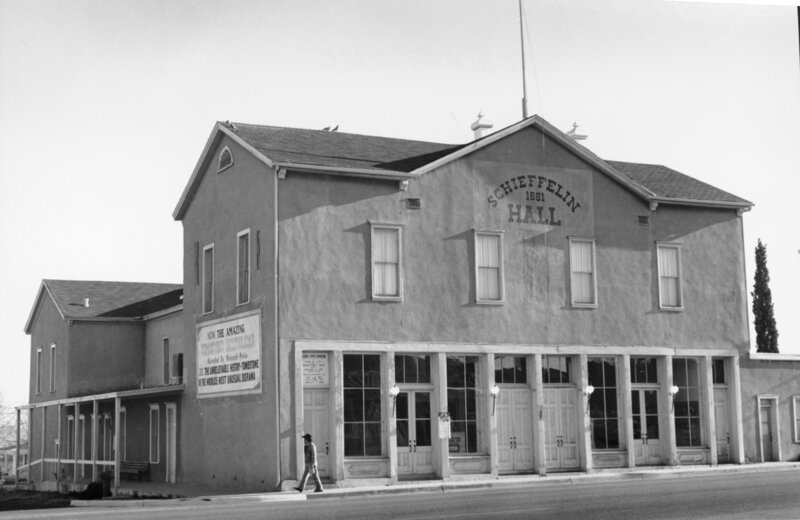
Today the hall serves as a civic center for city council meetings, fundraisers, and performances, and it is often described as the largest standing adobe structure in the Southwest.
Visiting
The hall stands on Fremont Street, a block off the Allen Street crowds, and most visitors walk past it. Stop in front and remember that the first music made here was a brass band playing under an unfinished roof.
Sources
- Tombstone Restoration Commission. Tombstone's Historic Locations (2008), Location 8. [Source for the June 8, 1881 opening, seating capacities, the Colorado drop curtain, King Solomon Lodge, the Irish Land League ball, The Ticket-of-Leave Man, and the National Register date.]
- Underhill. "If You Go, You Must Dress Up." 2016. [Source for the hall's dimensions, construction, tenants, and early events.]
- McCormack. "Safeguarding Its Past, Securing Its Future." Journal of Arizona History 54, no. 2 (2013). [Source for Harold O. Love's restoration campaign and the hall's present use.]
- Schieffelin Hall. Wikipedia. [Source for the Detroit investors' purchase, the lapse in maintenance after 1917, and the 1979 deed to the city. Its dates for the restoration (1963) and purchase (1964) differ.]
- Parsons, George Whitwell. Journal, Volumes 1 and 2. [Source for entries of September 5, 1881; April 8, 1882; September 4, 1883; February 21, 1884; February 18 and 19, 1886; and April 1886.]
- Tombstone Weekly Epitaph, February 13, 1882 (fire department benefit); February 27, 1882 (Solomon Lodge ball, reported in the daily of February 24); April 10, 1882 (Sherman reception); May 20, 1882 (Pinafore); July 8, 1882 (Fourth of July program and Dibble's oration); September 30, 1882 (Republican County Convention).
- The Tombstone, March 25 and April 2, 1885 (cemetery water-pipe benefit and cast list).
- Bailey, Lynn R., ed. Tombstone from a Woman's Point of View: The Correspondence of Clara Spalding Brown. 1998. [Source for Lost in London and the Daily Nugget review.]
- Prospector obituary of Ed Schieffelin (May 24, 1897), as reprinted in Traywick, Ben. Death's Doings in Tombstone. [Source for the funeral held in the hall. Traywick's own narrative is unreliable, so only the reprinted primary source is relied on here.]
- Sanborn Fire Insurance Maps, Tombstone, Arizona, July 1886 and January 1889.
- Photographs courtesy of the Arizona Memory Project.