
The Fremont Street Gallery
Before the Fremont Street studio opened, Fly briefly operated a photographic gallery in Charleston, nine miles southwest of Tombstone. The Tombstone Nugget reported in January 1880 that he was doing "a large business" there. Whether the Charleston gallery ran concurrently with or just before the Fremont Street operation is not documented.
The Fly property on Fremont Street was two buildings: a boarding house in front, where Mollie managed guests and kept the household accounts, and the photography gallery in the rear. The arrangement put the Flys at the social center of a booming town. Miners, gamblers, lawmen, and politicians all sat for portraits. Soldiers passing through on their way to the San Pedro Valley campaigns stopped in. Prominent visitors posed for cards to send home.
Fly's first exposure to a statewide audience came in July 1880 when journalist Thomas Gardiner published the premiere issue of The Arizona Quarterly Illustrated, probably the territory's first illustrated journal, featuring two engravings from Fly photographs. One showed the Sulphuret mine; the other captured the elegant bar fixtures of the Alhambra Saloon. The October issue added a view of Tombstone from a distance, to which the engraver added a fanciful Native American figure in the barren foreground. Fly had nothing to do with that addition, but the images confirmed his reputation as the town's most capable visual chronicler.
He did not work alone. Newspaper accounts from the period confirm that Mollie actively participated in the studio work and operated the gallery during Fly's frequent field trips. His absences could last weeks. She kept the business running through the boom years and for at least a decade after his death.
Present at the Gunfight
On the afternoon of October 26, 1881, Fly was in his gallery when gunshots erupted a few steps away in the vacant lot between C.S. Fly's Photography Gallery and the Harwood house. The fight lasted roughly thirty seconds. When it was over, three men were dead and three others wounded, including Virgil and Morgan Earp.
Fly walked out into the aftermath. According to a deposition given by eyewitness Bob Hatch, Fly approached the mortally wounded Billy Clanton, who was still clutching his pistol and calling for more ammunition. Fly pointed at the gun and said to no one in particular, "Take that gun away from that man." Hatch replied, "Go get it yourself if you want it." Both men grinned, walked over together, and Fly removed the pistol from Clanton's hand.
He did not photograph any of it. His camera was in the gallery. The most famous moment in Tombstone's history happened within earshot, and Fly chose not to document it. No explanation survives. Whether he thought the scene too grim, or the moment too dangerous, or simply reacted as a neighbor rather than a journalist, we cannot know. What we do know is that no photograph of the gunfight, its immediate aftermath, or the three dead men was ever taken. The most photographed event in the history of the American West was never actually photographed at all.
Into Geronimo's Camp
In late March 1886, General George Crook traveled south of the border to Cañón de los Embudos, in the mountains of Sonora, to negotiate the surrender of Geronimo and his band of Chiricahua Apache. It was a tense, uncertain meeting. The Apache were armed, suspicious, and had broken off negotiations before. The Army officers accompanying Crook understood they were in a volatile situation.
Fly was there. How he learned of the impending meeting is not documented. The Daily Tombstone reported on March 20 that he had left for Guadalupe Canyon with his photographic apparatus. He joined the column at Silver Creek and traveled with the soldiers to the canyon. He had no prior authorization from the Army.
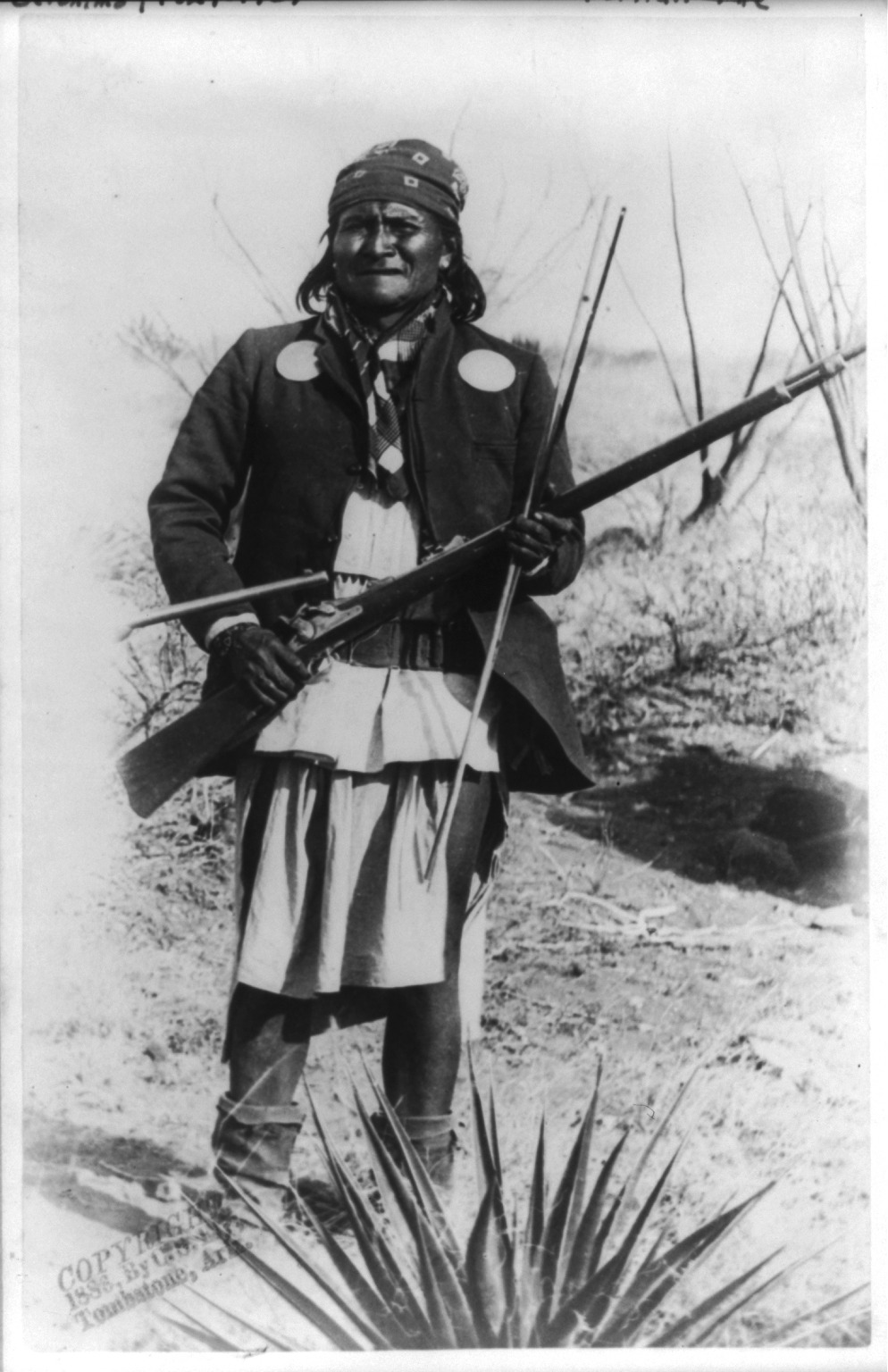
Captain John Bourke, who was present throughout the negotiations, recorded what Fly did next. Before talks began, Fly picked up his equipment and walked into the Apache camp alone to make photographs.
Mr. Fly, the photographer... with a "nerve" that would have reflected undying glory on a Chicago drummer, coolly asked "Geronimo" and the warriors with him to change positions, and turn their heads or faces, to improve the negative.
Captain John G. Bourke, On the Border with CrookTucson mayor C.M. Strauss, also present, described what he saw: "Fly is an excellent artist and he was not a respecter of persons or circumstances, and even in the midst of the most serious interviews with the Indians, he would step up to an officer and say 'just put your hat a little more on this side, General. No Geronimo, your right foot must rest on that stone.'"
Over three days of negotiations, Fly made approximately fifteen exposures on eight-by-ten glass negatives. He entered the camp repeatedly, photographed Geronimo, Naiche, and their warriors, and documented Santiago McKinn, a captive white boy who had been living with the band. One of the prints was captioned, "This group taken by special request of Geronimo."
Geronimo agreed to Crook's terms, but broke away two nights later after an American trader sold whiskey to members of the band and warned them they would be killed when they crossed back into the United States. The failed surrender cost Crook his Arizona command. Geronimo would not surrender for another five months, this time to General Nelson Miles.
When the final surrender came on September 4, 1886, Tombstone citizens telegraphed General Miles: "Cochise County appreciates your grand success." But the satisfaction was brief. General Miles defied orders and put Geronimo aboard a train before any civilian trial could be arranged, and the Tombstone Epitaph turned hostile within two weeks: "Why not stop talking about it and hang him?" On September 13, 434 Chiricahua and Warm Springs Apaches were shipped to Florida.
Six weeks after the surrender, on October 15, 1886, Fly photographed Captain Henry W. Lawton in Tombstone. Lawton had led the four-month Army pursuit through the Sierra Madre and was the first officer to make direct contact with Geronimo at Fronteras, Sonora. The portrait was made before Lawton's departure for Washington D.C. and his promotion. It is a quieter image than the Geronimo photographs, but it completes Fly's visual record of the Apache campaign.
Back in Tombstone, Fly copyrighted fifteen views and sent them to Harper's Weekly. Engravings of six photographs appeared in the April 24, 1886 issue under the editors' announcement: "The photographs of the Apache War, reproduced in this issue of Harper's Weekly, are from negatives taken by C. S. Fly, and are the only photographs ever taken of a hostile camp before surrender." Print copies sold for fifty cents each or four dollars a dozen; images showing Geronimo with Crook or with his warriors sold for a dollar each.
George Parsons, Fly's Fremont Street neighbor and a regular customer of the studio, was among the first to see the prints.
Good pictures of Geronimo and his cutthroats by Fly. He showed me some this A.M. He'll make money. Wish now I'd got a horse and gone with him.
George Parsons, Journal, April 1886Three days later Parsons bought seven prints. He noted that Fly had told him about entering the camp, and that Captain Bourke had told Fly he was "a d___d fool for going into the camp and that he'd never come out." An interpreter, less frightened than the officers, had gone in with him.
The Earthquake and After
In May 1887 a massive earthquake centered at Bavispe, Sonora, shook the entire region, cracking walls in Tombstone and collapsing adobe structures across northern Mexico. The U.S. government commissioned a scientific survey of the damage, led by Fly's neighbor and occasional subject Dr. George Goodfellow, Tombstone's celebrated surgeon. Fly accompanied the expedition, photographing land faults, destroyed buildings, and survivors in the Mexican towns. Four of his photographs appeared as engravings in Frank Leslie's Illustrated Newspaper on March 24, 1888, including an image from Baceras showing townspeople kneeling in prayer before a statue of the Virgin Mary.
By the early 1890s the silver boom that had built Tombstone had wound down. The deep mines faced serious flooding challenges, and the largest mills had curtailed operations. Fly adapted as best he could. In the summer of 1891 a wandering eccentric appeared west of town, naked except for sandals and a skull cap, claiming to subsist on mud mixed with mesquite leaves and quoting the Bible and Greek mythology. Arrested for indecent exposure and sentenced to thirty days, the self-named "O. Homo" attracted women's love letters from across the West and a daily column in the Tombstone Prospector. Fly paid him five dollars to pose in the studio. The Prospector reported that "pictures of O. Homo are in demand, and C.S. Fly is selling large numbers of them." The San Francisco Chronicle published an engraving. After serving his sentence, O. Homo disappeared down Toughnut Gulch and was never seen again.
Sheriff, Then Bisbee
In November 1893 the Flys moved to Phoenix and opened a studio. When that venture failed, they returned to Tombstone. It was not Fly's first run at the sheriff's office; he had lost a bid in 1892 before finally winning election in November 1894, defeating Scott White by 305 votes. Tombstone's own contemporary sources have Fly running as a Democrat, endorsed by the legendary John Slaughter; a later source, Cochise County Stalwarts, instead identifies him as a Republican in both his 1892 and 1894 runs. The discrepancy is not resolved.
His term produced one significant embarrassment. On January 15, 1895, two men robbed a Southern Pacific train near Willcox. Fly was in Benson at the time and heard the dynamite explosion that blew the express safe. According to the Tombstone Prospector, "the Sheriff tried to get someone to go with him at once, but they evidently thought discretion the better part of valor and waited until morning." The posse's late start cost them the trail. Compounding the situation: the San Francisco Chronicle ran a copy of a Fly studio portrait of one of the robbers, Grant Wheeler, who had previously sat for a portrait in Tombstone. Wheeler was later cornered on a Colorado ranch and killed himself; his partner was never caught.
The high point of Fly's term, by his own department's later reckoning, was the pursuit of the High Five Gang, five outlaws that included Black Jack Christian and "Three-Fingered Jack" Dunlap, though the gang ultimately gave lawmen the slip and escaped into Mexico. Fly did not seek re-election when his term expired in 1896.
He moved to Bisbee in 1897, where the copper mines were producing steadily and offered more work for a photographer than the quieter streets of Tombstone. He continued photographing, contributing images to mining company brochures and tourist publications. In 1900 he helped produce Souvenir of Bisbee, the town's first tourist booklet. One portrait from that project had an outsized legacy: a studio image of George Warren, posed leaning on a pick with a shovel and rifle, captioned "Discoverer of the Copper Queen Mine." The legend was Warren's own invention; county records show he did not actually file the original copper claim. Regardless, when Arizona adopted its state seal in 1912, the miner depicted was modeled on Fly's portrait of Warren.
By early 1899 Fly was in financial difficulty and had contracted erysipelas, a painful skin infection. He and Mollie separated around this time. Camillus Fly died in Bisbee on October 12, 1901, at age fifty-two, of acute alcoholism; his funeral was arranged by the Tombstone Lodge No. 3 of the Ancient Order of United Workmen. He is buried in the Tombstone Cemetery. Mollie returned to Tombstone and continued operating the gallery for at least a decade.
What Survives
In 1915, fourteen years after Fly's death, a fire swept through his Fremont Street gallery and destroyed the photographs and negatives still on display there. Most of his Tombstone-era work was lost. What remains are the Geronimo photographs, scattered prints that had already left Arizona before the fire, a portrait of George Parsons in his Sonora expedition gear (reproduced as the frontispiece of the published Parsons journal), and the George Warren image now associated with the Arizona state seal.
Fly's recognition as a photojournalist came long after his death. He practiced the craft before the term existed, recognizing the documentary value of field photography at a time when most photographers stayed in their studios. He entered a hostile camp when soldiers held back, documented a natural disaster in a foreign country, and turned a wandering eccentric into a regional celebrity, all in service of a medium he understood better than almost anyone in territorial Arizona. The Harper's Weekly editors said it plainly in 1886: the only photographs ever taken of a hostile camp before surrender.
Sources
- Vaughan, Thomas. "C. S. Fly: Pioneer Photojournalist." Journal of Arizona History 30, no. 3 (1989): 303–318.
- Voeltz, Richard A. "'What Will Occur, No One Can Tell': Henry W. Lawton's Account of the 1886 Geronimo Campaign." Journal of Arizona History 57, no. 4 (2016): 405–422.
- Bourke, John G. On the Border with Crook. New York: Scribner's, 1891.
- Parsons, George Whitwell. The Private Journal of George Whitwell Parsons, Volumes 1 and 2. Arizona Historical Society.
- Tombstone Restoration Commission. Tombstone's Historic Locations. Tombstone, AZ: TRC, 2008. Historic Location #5.
- Fulton, Richard, and Conrad Bahre. "Charleston, Arizona: A Documentary Reconstruction." Arizona and the West 9, no. 1 (1967): 41–64.
- Turcheneske, John A., Jr. "The Arizona Press and Geronimo's Surrender." Journal of Arizona History 14, no. 2 (1973): 133–148. [Source for Tombstone citizens' telegram to Miles, Epitaph editorials, and the September 13 mass removal.]
- Bailey, Lynn R., and Don Chaput. Cochise County Stalwarts: A Who's Who of the Territorial Years, Vol. 1, pp. 129–130. [Source for the 1892 sheriff run, the party-affiliation discrepancy, the High Five Gang manhunt, and late-life detail including cause of death and funeral arrangements.]