Warren Tulley
Every few winters a snow drops out of the Dragoon Mountains that has no business falling on the desert, and on those nights the old-timers in Tombstone still tell newcomers to watch the Charleston road for a light that shouldn't be there.
It was the night of January the 9th, 1891, when nineteen-year-old Warren Tulley learned why.
Warren had ridden into Tombstone that afternoon to fetch a wagon part for his father's ranch out past Contention, and by the time the part was soldered and wrapped he'd lingered too long over supper at a boarding house on Fremont Street. He should have started home before dark. Instead he rode out of town just as the sky went the color of a dead man's hand, and within the hour a wind came down off the mountains carrying snow so thick and so fast that Warren lost the road entirely. His horse, Duke, fought the drifts until his flanks were heaving and lathered with ice, and Warren's own hands had stopped answering him properly inside his gloves.
He might have died right there on the Charleston road if he hadn't seen the light.
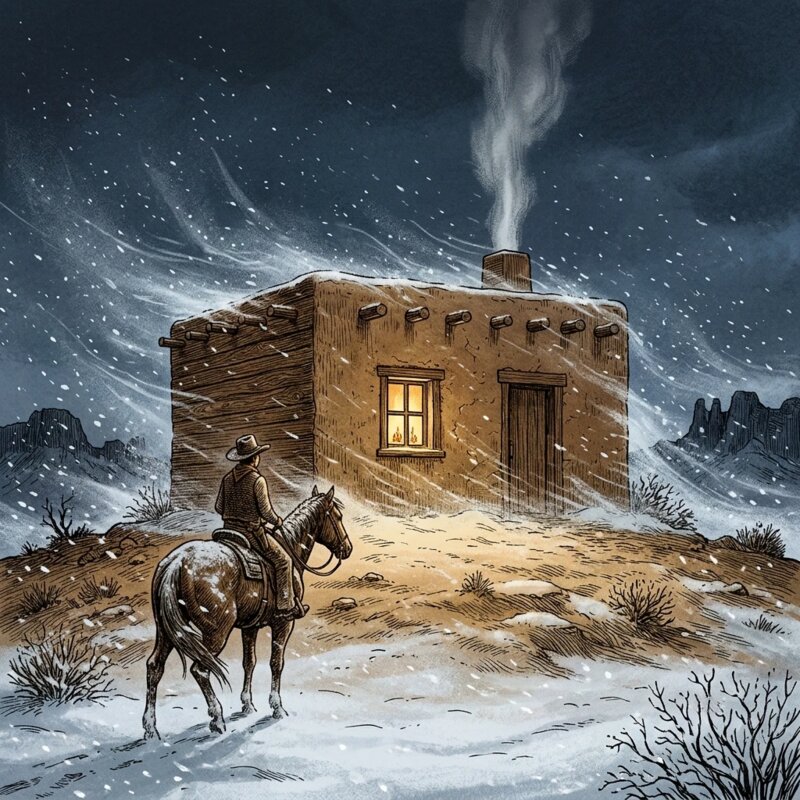
It sat low and warm through the blowing snow, a single square window glowing gold, and Warren turned Duke toward it without a second thought. As he got closer he made out an adobe house, small and square, smoke rising straight up from its chimney despite the wind, as if the storm had no claim on that one patch of ground. A dog barked once inside and went quiet. Before Warren had even swung down from the saddle, the door opened and a heavyset man with a gray beard was waving him in out of the weather, calling him "son" like he'd been expected.
The inside of that house was the warmest room Warren had ever stood in. A woman about the man's age took his frozen coat and hung it by the fire, and set a plate of beans and cornbread in front of him before he'd even gotten his boots off. They introduced themselves as the Kestlers, and Warren was too grateful and too cold to think it strange that the furniture looked older than anything he'd seen even in his own grandmother's house, or that the calendar tacked up by the door read December of a year that had already passed twice over. Mrs. Kestler kept glancing at the window every few minutes the whole time she was feeding him, like she was watching for something out in the snow. When Warren asked if she was expecting someone else, she just patted his hand and told him to eat.
Mr. Kestler pulled a chair by the fire for him afterward and the two of them talked until Warren's eyes got heavy — about cattle prices, about a boy Kestler had lost track of years back, about how a man ought never turn away someone who comes knocking on a night like this one. He said that last part twice, staring at the fire instead of at Warren, and something in his voice made Warren not ask what he meant. The last thing Warren remembered was Mrs. Kestler pulling a quilt up over his shoulders as he dozed off in the chair, and the dog, somewhere in the house, giving one low, contented sigh.
Warren woke up on frozen ground with the sun in his eyes and Duke nosing at his shoulder.
There was no house. There was no fire, no quilt, no Kestlers. Warren was lying in the open on a low rise above the Charleston road, half a mile past where he remembered losing the trail, and the only sign that anything had ever stood there was a low, square outline of foundation stones half buried in the sand, and the blackened stub of a chimney standing alone against the morning sky. The storm had passed in the night, leaving the desert glittering and silent. Warren's coat was dry. His hands worked fine. He was, by any measure, a man who should have frozen to death and hadn't.
He rode back into Tombstone shaking, and it was Otis Flannery at the livery stable who finally made sense of it for him. Otis had grown up out past Contention and remembered the Kestler place well enough — a family that had lived on that same rise above the Charleston road back in the seventies. Otis told it the way his own father had told it to him: that on a night of freak snow in December of 1879, a peddler on foot had come pounding on the Kestlers' door, half dead with cold, and old man Kestler, spooked by a rash of highway robberies that same month, had refused to open it. He'd shouted through the door that the peddler should keep moving, that he wasn't taking chances on strangers in the dark. The peddler's frozen body was found the next morning less than a hundred yards from the Kestlers' porch.
Kestler was never right after that, Otis said. He barely spoke through the whole next year, and folks said his wife took to leaving a lamp burning in the window every night, rain or shine, like she was still hoping to call somebody in from the cold. The house burned to its foundation the following winter — a lamp left too near a curtain, most figured, though nobody in town ever quite believed that was an accident. Kestler and his wife both died in that fire.
Otis Flannery never once accused Warren Tulley of lying, and neither has anyone else who's heard the story since. Every few winters, when that same impossible snow rolls down out of the Dragoons, somebody caught out on the Charleston road after dark reports a warm light where no house has stood in over a hundred years — and every time, without exception, the traveler is found alive the next morning, cold and disoriented, but alive.