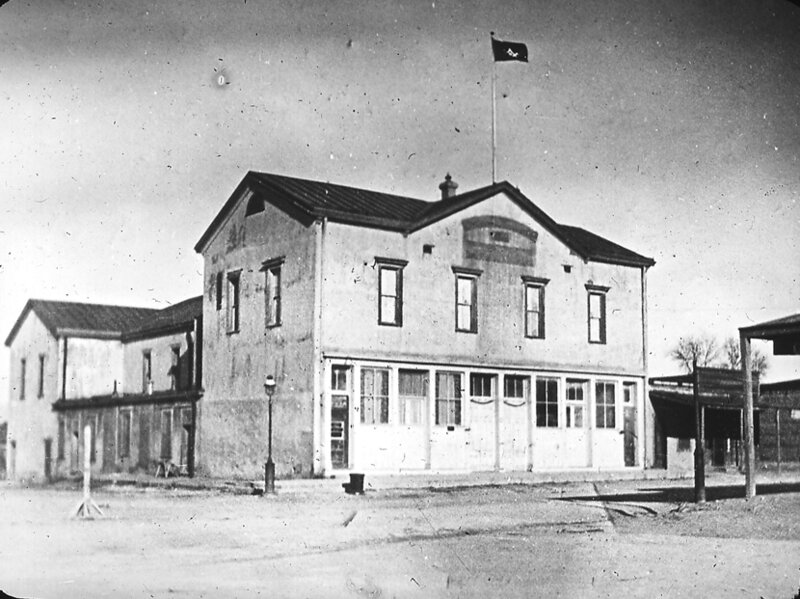
A Holdup at Noon
On Friday, November 2, 1917, a gunman walked into the First National Bank of Tombstone during the noon hour. The cashier, T. R. Brandt, was alone in the building. Brandt made a quick move toward the bank's shotgun, and the robber, Fred H. Koch, shot him below the heart, ran out, jumped on his horse, and headed east toward Gleeson. Chief Deputy Sheriff Guy Webb chased him two miles in a Ford racer driven by Immigration Inspector Jeff Milton, and Koch was caught. Brandt lingered until December 10.
It is exactly the Tombstone story people expect. The story of what happened to the same bank four years later is stranger, and it turns on a woman who has been almost entirely forgotten.
A Beer Hall and a Copper Fortune
Mary McNelis was born in Donegal, Ireland, in 1867. Her future husband, Martin Costello, was a cabinet maker from near Dublin. The two emigrated separately, met in Philadelphia, and followed the opportunities of the American West to Tombstone. Peter Huntoon, whose 1989 article is the main source for this account, dates their arrival to 1887, when Martin was forty-one and Mary was twenty-one. Martin opened a small saloon on Fremont Street.
Other evidence suggests Martin was in town earlier. Huntoon himself quotes a Tombstone Prospector item of February 1882 about "the first carload of Anheuser Busch keg beer to go into Martin Costello's new cold storage rooms on Fremont Street," and Cochise County Stalwarts says Martin came in the town's infancy. By 1890 he held the Anheuser-Busch franchise for Tombstone, Benson, Fairbank, Bisbee, and Nogales, and was known as "the Beer King of Tombstone." The sources do not settle when the family arrived.
Martin's real fortune came from copper. The popular story was that he befriended a hungry prospector, fed and sheltered him, and was repaid with a claim that netted Martin $60,000. He went on to the Irish Mag at Bisbee, which became one of the great copper properties of the Southwest and the foundation of the Calumet and Arizona Mining Company. The sources disagree on the details. Huntoon has Martin investing $50,000 and selling for $750,000 two years later, while Stalwarts describes eleven claims, a title fight carried to the Supreme Court, and a sale to Michigan investors in September 1899 for $550,000. Either way, his fortune was estimated at four to five million dollars. His attorney, Ben Goodrich, said Martin never lost money on an investment.
In 1902 Martin moved the family, by then five boys and five girls, eight of them born in Tombstone, to a large house on South Figueroa Street in Los Angeles. He kept commuting back to Arizona. In September 1911 he died by his own hand in Los Angeles. The accounts differ on the exact day, the place, and the illness that was weighing on him, but not on the outcome.
A Widow with an Estate
Mary was forty-five, and she had been, in Huntoon's words, a rather typical turn-of-the-century Victorian homemaker. Her eldest son was nineteen and her eldest daughter sixteen. Suddenly she was the sole heir to a vast and tangled estate: at least fifty mining claims, real estate in half a dozen Arizona towns and Los Angeles, and a portfolio of bank stocks and school bonds.
She learned fast. In April 1912 the heirs of Martin's former partner Patrick Cunningham sued the estate for $525,878.34, alleging that Martin had not dealt fairly with Cunningham's widow over seventeen claims near Bisbee. The case was appealed repeatedly for seven years. Three of the thirteen attorneys involved died before it ended, and it settled on March 9, 1919, for about $200,000. Among the properties she inherited was the Willard Hotel in Tucson, then the city's largest and most luxurious, which she managed herself for a time. In July 1920 she sold her entire Pima County holdings, the Willard included, for a quarter of a million dollars. By the early 1920s she was the largest property holder in Tombstone, although she lived in Los Angeles and owned only a small block of stock in the town's bank.
The Cashier
After Brandt's death the bank went through two stopgap cashiers before settling on a replacement. Maurice M. Bludworth moved to Tombstone in 1919 with his wife. The couple blended into the community easily, and he was remembered as a very fine young man. He also fell in with a crowd of go-getters enjoying the postwar stock boom. In a town of about 1,500 people, the day's stock quotes were chalked up each afternoon on a big blackboard in the ice cream parlor at Bill Boyd's drugstore.
Beginning around the start of 1921, as the market soured, Bludworth began moving money. According to the later indictments, he used two companies, the First Cattle Loan Company and the Solstice Mining and Milling Company, to juggle deposits and bogus loans. Meanwhile the postwar farm depression was hurting southern Arizona's cattlemen, and people in town began to pay some attention to the bank, though not yet great concern.
A Letter of Assurance
On Monday, August 15, 1921, the Prospector ran a front-page headline: "First National Bank Changes Management." A meeting the previous Saturday had removed the bank's president, William Cowan, and Bludworth. The new slate put Mary M. Costello in as president and her daughter Ruth Costello as one of two vice presidents. Mary released a letter promising that the bank would be kept in the most solvent condition possible. To the depositors she wrote: "I have no hesitancy in saying that their interests will be fully protected by me."
It is not clear why she was in Tombstone that weekend, whether she came specifically to buy into the bank or was visiting her old hometown when the opportunity arose. She knew some of the loans were slow. She did not know how bad the books were. She went straight back to Los Angeles to confer with her attorney, William A. Bowen, who looked at what he could find and told her to back away and close the bank pending a full investigation.
On Friday, August 19, the Prospector announced: "First National Bank Closes Doors Today." The federal bank examiner R. H. Collier took charge, and Mary publicly repudiated her broad guarantee on her attorneys' advice. The paper's editors were furious. They had printed her assurances in good faith, and depositors had left their money in the bank, and even made new deposits, right up to the day it closed. The paper urged the hundreds of depositors to organize.
Keeping Her Word
Mary Costello now had a choice. She could cut her losses, let a federal receiver liquidate the bank, and live with having broken her word to a town where she still had friends. Or she could cover the bad paper herself. Huntoon says no record survives of her exact maneuvers, but the outline emerges from the newspaper coverage, and it shows a shrewd negotiator. Before she spent a dollar, she extracted concessions from everyone involved.
Over the next twelve weeks, a succession of federal examiners went through the books. Alexander Bailey McCans, a national bank examiner from Dallas, arrived as temporary receiver in September. A depositors' committee agreed to leave its money in the bank for at least six months after any reopening, provided she covered the questionable loans. A rival banker, A. G. Smith of the Cochise County State Bank, tried to buy the good assets and so eliminate a competitor, but nothing came of his offer. She also bought up the remaining outstanding stock.
The largest single problem was a bond. Cochise County had $92,000 on deposit in the bank, covered by a $97,000 surety bond held by the United States Fidelity and Guaranty Company. The bonding company was therefore the bank's biggest creditor. On October 21, 1921, Bowen telegraphed the Prospector that Mary had agreed to buy the bonding company's interest at a discount. That same day the company delivered a check for the bond's full face value to the county supervisors in Tombstone, and the supervisors returned the $5,000 difference. The bond had been the worst liability on the table, and settling it put substantial cash into the bank.
The bank reopened on November 10, 1921, with a new cashier, J. P. Connolly, a Nova Scotia graduate who had spent nineteen years rising to assistant cashier at the Bank of Bisbee. His hiring was a public relations coup. Not a single depositor withdrew a dollar on opening day, and a number of new accounts were opened. The bank adopted a new slogan, "the bank of courteous service." The Prospector was jubilant:
Mrs. Costello in her loyalty and interest in Tombstone deserves the highest commendation. ... she has come to the rescue with funds running well into six figures, rather than allow the matter to go through the hands of a receiver. Confidence in the people and future of the Old Camp inspired her to back up the institution with the result that when it opens its doors tomorrow it will stand out as one of the strongest financial institutions in the United States.
Tombstone Prospector, November 9, 1921, as quoted by Peter HuntoonHuntoon estimates that the rescue cost her about $100,000, which he notes derailed the budding career of her daughter Ruth as a lawyer in southern California and planted her in Cochise County for good. The reopening date is one place where sources disagree. Huntoon, citing the Prospector, gives November 10, while a database of 1921 newspaper coverage lists the formal reopening a few days later.
The Reckoning
While the bank was closed, the audit of its books pointed straight at Bludworth. He was arrested in late September 1921 and taken to Tucson, and at a preliminary hearing on October 6 the federal examiners testified that he had taken $15,000 from the bank and put it into the First Cattle Loan Company. Ironically, it was bond money that had been deposited as a surety for county funds embezzled by a former assistant county treasurer. Bludworth had used $8,000 of it to cover a deposit his brother had entrusted to the bank without proper bookkeeping, and the rest to cover his own debts.
That was only the first of twenty-four separate federal indictments. As the examiners worked through the books they found falsified entries, bogus loans, worthless paper discounted for friends, and false reports to the Comptroller of the Currency. In one odd detail, he misapplied $7,192.14 of the bank's money to buy forty shares of its stock for himself. A jury convicted him on December 15, 1923, and on December 24 he was sentenced to three years in the federal penitentiary at Leavenworth and fined $5,000. He later pleaded guilty in a third case. Leavenworth records show he was released on May 18, 1926. Of the several people named in the indictments as associates, only one was convicted, a man named K. N. Coplen, who happened to be a director of the rival Cochise County State Bank.
After the Bank
Mary returned to Los Angeles a few days after the reopening. Ruth stayed, first as assistant cashier and then as cashier when Connolly left in 1925, and Mary's son Martin Costello joined the board. Another son, Cecil, ran the Sycamore Springs Ranch in the Cochise Stronghold country northeast of Tombstone and served in the trenches of World War I, rising to sergeant. On May 12, 1926, Mary sold the bank to A. G. Smith, saying she wanted to devote her energies to her California affairs. The First National Bank of Tombstone was formally liquidated nine days later, ending a run that had begun in 1902.
The sale had a sad aftermath. In September 1931 the First National Bank of El Paso, which held the Cochise County State Bank's reserve funds, failed, and Smith's bank closed with it. Over the next five years its depositors recovered just 37.25 percent of their money. The depositors of the First National Bank, by contrast, had been made whole.
Mary lived out her life in Los Angeles and died on December 12, 1941, at the age of seventy-four. She outlived at least two of her adult children. According to Cochise County Stalwarts, her daughter Evelyn earned a law degree from the University of California in 1919 and died of pneumonia, following influenza, in Los Angeles that April before she could practice. Her son Adrian, who also earned a University of California law degree, was killed on November 3, 1924, at the age of twenty-five. He was returning from a football game at Berkeley when his car broke down on the Ridge Route near Saugus. He hailed a passing car and jumped on its running board as it slowed, and a passenger, thinking he was a bandit trying to hijack the car, shot him.
In 1924 the Tombstone Epitaph called her "a capitalist and business woman, well known for her financial standing throughout the Southwest." Huntoon thinks she has been forgotten because she was a woman and her story did not fit the bullet-ridden image of Tombstone that later historians preferred. That may be right. The town has spent a century celebrating its gunmen, but when its bank failed, it was a widow from Donegal who kept her word to depositors she had never met. For other women who made their mark on the town's economy, see Ladies of Enterprise.
Sources
- Huntoon, Peter. "Mary M. Costello and the First National Bank of Tombstone, Arizona." Paper Money, Whole No. 142, 1989, pp. 118-125. Read the article (PDF). [Main source for Mary and Martin Costello's biography, the 1917 holdup, the 1921 crisis and reopening, and the Bludworth prosecution. Huntoon draws on the Tombstone Prospector (August 15 to November 10, 1921), federal criminal dockets and indictments from the District of Arizona, Leavenworth records, and reports of the Comptroller of the Currency.]
- Bailey, Lynn R., and Don Chaput. Cochise County Stalwarts: A Who's Who of the Territorial Years, Vol. 1. Entry on Martin Costello, pp. 75-76. [Source for the alternate account of Martin's business career, the Irish Mag sale, the Beer King nickname, and the deaths of Evelyn and Adrian Costello.]
- First National Bank (Tombstone, AZ). Financial History bank-run database. [Transcribes 1921 coverage from the Tombstone Epitaph, Bisbee Daily Review, and other newspapers. Source for the conflicting reopening date and Bludworth's September 1921 arrest.]