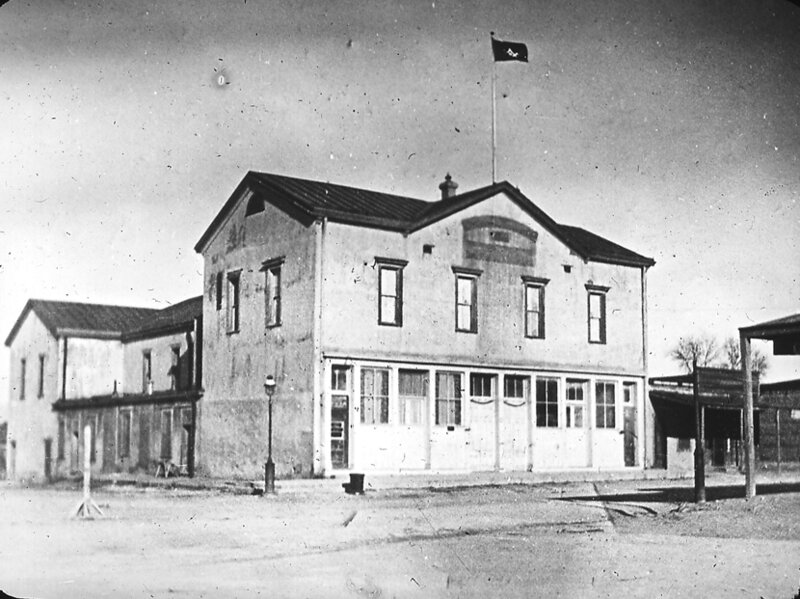
Seventeen Hours Uphill
Regular stage service to Tombstone began before the town had a church or a school. John Kinnear, an Ohio-born driver who had come across Arizona from Silver City, New Mexico, with a Concord coach and a pair of mules, reached Tucson in October 1878 and went into business at once. His first advertisement, in the Tucson Arizona Citizen on November 16, 1878, offered one coach a week, driven by an agent named Sam Childs, at ten dollars each way. A young Allen Street merchant named A. J. Cadwell soon countered with a "Pioneer Tombstone Stage Line" at seven dollars, which the dated newspaper advertisements collected in Thomas Peterson's 1968 University of Arizona thesis on the Tombstone stage lines first show in January 1879 and which faded within months. (Another popular history places Cadwell's wagon at Watervale in the summer of 1878, which would make it the earlier line. The two accounts do not fit together neatly.) By the autumn of 1879 Kinnear had a serious rival: the stage line formed in September by William Ohnesorgen and Howard C. Walker.
The trip was roughly seventy-five miles and it was not gentle. In the early days the road climbed toward Tombstone for about seventeen hours, and the Tucson road had a reputation for cattle thieves and Apache raiders. Travelers endured a blazing sun by day and cold, windy nights. When George Parsons arrived in February 1880, the railroad had not yet reached Tucson, and he made the last leg of his journey on a stage carrying eleven other passengers, rolling into Tombstone at 6:30 in the evening.
Competition kept the fares moving, and it was not always friendly. When Ohnesorgen and Walker's first coach left Tucson on September 19, 1879, advertising a thirteen-hour trip at seven dollars, Kinnear undercut them at four, and both coaches filled and raced. Kinnear's won, in eleven hours and forty minutes, while the new line's coach lost a wheel nut and overturned (no one was hurt). In the following weeks a team of the new line's horses was poisoned and an axle nut was removed from one of its coaches overnight. Both lines moved to six-horse teams, and trips fell to nine or ten hours. A passenger on one of those rides wrote in his diary that the driver had orders to "drive fast to beat opposition stage," and that the horses were "on dead jump all of the time and nearly dead" when they reached Contention. The Star asked who "prompts and pays" for the sabotage. In December 1879 the fare war pushed tickets down as low as three dollars, and Ohnesorgen mortgaged his ranch to stay in business. The rivals finally settled on Christmas Day at seven dollars each way. Even then Kinnear's advertisements kept up the rivalry, boasting of grass, timber, mountain scenery, and "no eggnog in the bill."
One race had a prize. The mail from Tucson to Tombstone had been carried late and erratically by a contractor with an eastern Star Route contract, and in February 1880 a post-office inspector toured the road and recommended Walker's line. On February 22, which was also Washington's birthday, Walker sent the first mail coach out draped in American flags, with orders to beat Kinnear to Tombstone at all costs. It arrived at full run, just ahead, and Parsons wrote, "Regular mail at last."
The Benson Run
Everything changed when the Southern Pacific reached Benson in 1880. Benson was only about twenty-five miles from Tombstone, and a coach could make the run in about six hours, less than half the time the Tucson trip required. Tombstone's traffic swung toward the new rail stop. For a time the two old rivals joined forces as the Arizona Mail and Stage Company, and the partners slowed their coaches and raised the Benson fare to ten dollars, which brought angry complaints from the Tucson newspaper. Walker's six-horse coach left Tombstone at five each afternoon to meet the evening train, carrying passengers, light baggage, and the Wells, Fargo and Company treasure box. Kinnear's coach followed, but it carried only heavy freight and express.
The monopoly did not last. In June 1880 a veteran California driver named Robert Crouch, nicknamed "Sandy Bob" for his red hair and freckles, stepped off the train at Pantano and decided to start his own line. His first run on the Benson road, on June 21, ended with Walker's six-horse coach passing him and leaving his passengers to eat dust. He kept at it, though, and around the turn of 1881 he had bought a large old Concord from Wells, Fargo and Company that would become the most famous coach in Tombstone. (It is the subject of its own section below.) A third operator, Newton Smith, undercut both of them at two dollars and fifty cents. By the winter of 1880 and 1881 the Arizona Mail and Stage Company was running daily coaches from Tombstone to Benson, Charleston, Fort Huachuca, Harshaw, Contention, and Bisbee, and the Benson road was among the busiest in the territory. Stage drivers became local celebrities, and the racing of coaches down Allen Street was a popular spectacle. Competition never entirely stopped, either. In February 1882 the Epitaph noted an opposition stage between Tombstone and Contention, "making quick time and at reduced rates," while a proprietor of the McConkey and Karns stage line, in town from New Mexico, took a room at the Cosmopolitan Hotel.
Passengers could ride in style or in misery depending on the coach. In late January 1882 a young Episcopal minister named Endicott Peabody stepped off the train at Benson and found the Tombstone stage waiting: "a dilapidated old affair, covered with dust and drawn by 4 decrepit looking horses driven by Sandy Bob." He climbed on top without asking permission and refused to come down. The ride took six hours, and the driver, recovering from his sulk at so heavy a load, entertained the passengers with his own account of being "stood up" by two highwaymen three weeks earlier. (Peabody's story is told in Endicott Peabody: The Boston Parson Who Came to Tombstone.)
The road itself gave the travelers trouble. In the summer rains, washouts could leave the roads nearly impassable for days, interrupting the mail, the passengers, and the supply wagons alike, and leaving heavy quartz teams unable to reach the mills on the San Pedro River. In dry weather the opposite problem prevailed: the dust raised by coaches, freight wagons, and ore teams along Tombstone's streets was so bad in 1880 that residents needed daily baths, and since water was scarce, the bathhouses raised their rates.
Express, Messengers, and Trouble on the Road
The coaches carried more than people. Silver bullion left town by stage, and Wells, Fargo and Company employed armed messengers to ride beside the driver with a shotgun. Because the shipments were valuable and the roads were lonely, robbery was a real danger, and two attacks on the Benson road in particular shaped the history of the town.
The first came in March 1881, when robbers tried to stop the Benson stage. Driver Bud Philpot was shot through the heart, and a passenger was killed. Messenger Bob Paul, who had fired both barrels of his shotgun at the attackers, was remembered for the words he called as he did: "I hold for no one." Parsons was drawn into the posse that formed that night, and he wrote in his journal that the bullet a doctor showed him, the one that killed Philpot, was "an ugly .45 calibre." The episode helped set in motion the troubles that ended at the O.K. Corral.
The second attack came on the night of December 14, 1881, when the six-horse coach, driven by Jimmy Harrington, left Malcolm's water station, the last house on the road before Contention, and about four miles from Tombstone. A voice from the roadside ordered it to halt, and almost at once a volley was fired. The off-leader was killed. "Whistling Dick," driving the bullion wagon behind, took a ball in the calf but kept his seat. The coach ran on about half a mile before the wounded horse collapsed, and the passengers cut the leaders loose and pressed on. It was only when the coach reached Contention that someone noticed Mayor John Clum, who had been riding inside, was missing. Sheriff John Behan and others rode out through the night to search for him, and two teamsters camped at Malcolm's reported hearing the shots and seeing the flashes from both sides of the road. The Epitaph's follow-up report carried the headline "Mayor Clum Safe."
The Epitaph's readers took the matter seriously, and so did its rivals. One letter to the editor argued that the stage was carrying no bullion that night and that the attackers must have been after the mayor, since the shooters were reported to shout, "Be sure and get the old bald-headed son of a b---." The rival Nugget treated the story lightly, which the letter writer called "an insult to the intelligence of the community." Whether the attack was an assassination plot or a clumsy robbery was never settled to everyone's satisfaction, but it shows how quickly a stage on the Benson road could turn into political theater.
Ordinary accidents were common too. Parsons recorded one with a brevity that suggests how unremarkable it seemed: "Kinnear line stage upset tonight near Kinnears and badly hurt three or four. Doctor at once sent." Then he went on to the next subject.
The Freight Teams
If the stages were the glamorous side of transportation, the freighters were the muscle. Mining at Tombstone needed staggering quantities of timber, machinery, food, and ore moved over rough roads. Long teams of horses or mules hauled loaded ore wagons from the mines to the stamp mills along the San Pedro River at Charleston, nine miles off, and heavier ore bound for smelters went by sixteen-mule teams to Fairbank. Merchandise for Allen Street's stores, and supplies for the mines and the town's growing population, all came from the railhead at Benson by wagon.
The business was big enough that fortunes were made in it. In February 1882 the Epitaph reported that J. E. Durkee had bought ten ore teams and wagons from the Cerro Gordo freighting company and that J. Carr had purchased the remainder of the company's equipment, "making Mr. Carr the freighting king of Arizona."
The work was dangerous in ways that had nothing to do with mud. In April 1882, as an Apache breakout spread terror across eastern Arizona and western New Mexico, Epitaph readers learned that seven teamsters working for a Clifton firm had been killed in a single attack, and that the freight master for another company had lost five men and sixty mules near Clifton. The same issue carried news of an ox train attacked near Longfellow. Those events happened a hundred miles or more from Tombstone, but they reminded readers that every wagon driver on the territory's roads was exposed.
Wires, Mail, and Isolation
Information traveled faster than freight, though not by much at first. The Western Union telegraph line reached Tombstone in mid-July 1880 to considerable local excitement, and within a year the town could send a message to any point east or west on the territory's wires. By 1883 the telephone was in general use in Tombstone and Tucson, connecting the principal mines and offices.
The system still had weak links. A snapshot from Fort Huachuca's 1883 letter books shows how thin the network could be at its edges. Mail reached the post daily by stage from Tombstone, but the nearest telegraph station was a siding on the New Mexico and Arizona Railroad, seven miles from the post and connected to it by telephone, with government wagons covering the last stretch. In November 1883 the post commander complained that Western Union dispatches were being lost or delayed at the Contention relay point. In March 1882, a petition circulated in Tombstone to establish mail service to Sonora via Naco and Hereford, since the town had no connection with Mexico nearer than fifty miles to the west and a hundred to the east.
The Town Without a Railroad
The railroads came close without ever quite arriving. A line from Benson to Tombstone was organized in 1880 and abandoned, and the Santa Fe built a branch to Contention that opened in March 1882 and graded most of the way to Tombstone before work stopped in August. A third attempt, in 1888, ended when a pledge drive fell short and the route went to Bisbee. The full story of those false starts, and of the branch that finally opened in 1903, is told in the Railroad article.
Their absence did strange things to ordinary life. In March 1882, Parsons organized a riding party of six young women and several gentlemen to Contention City simply to look at a locomotive, since it was "a little more than two years since I had seen a steam engine." Later that year came a meeting that depended entirely on the railroad's absence. In late November his sister Emily left Boston on a special train bound for California, and Parsons had worked out that she would pass within reach of him on December 8. On that Friday he rode twenty-seven miles to Dragoon Summit Station, on the Southern Pacific line, and waited on horseback with a friend, Don Strong, who would take charge of the horses. When the train came into sight he saw his sister on the front platform of a Pullman car, dug in a spur, and was alongside and aboard within seconds. "She was almost as quick as I," he wrote. He handed his belt, pistol, and spur to Strong, rode with her as far as Tucson, entertaining the other passengers with tales of Tombstone, mines, Indians, and cowboys, and then said goodbye at dinner and jumped off into the dark. The visit lasted an afternoon. He called it "kaleidoscopic in the extreme," and it was his first time on a railroad train in nearly three years.
The Modoc
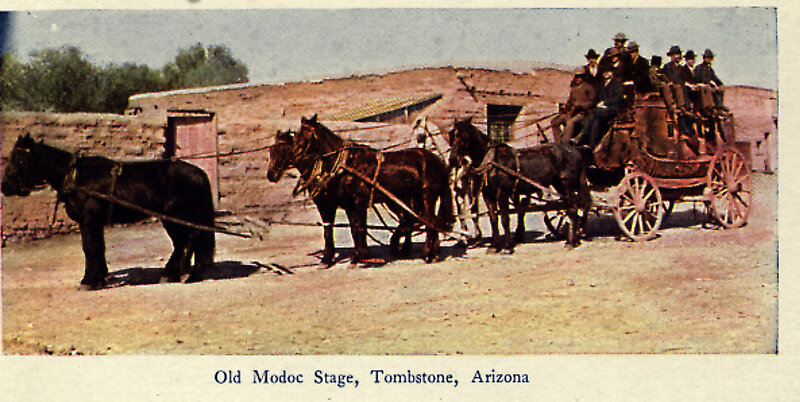
One coach became the symbol of all the rest. In late 1880 Sandy Bob Crouch bought an enormous six-horse Concord, said to have seen thirty years of service in California, from Wells, Fargo and Company and brought it over. According to Peterson, it was built to carry twelve passengers inside and nine outside, and had carried as many as thirty at once. Its body was painted red, its wheels and running gear straw yellow, and its trim black, with "U.S. Mail" over the doors, scenic panels on the door centers, gold-leaf scrollwork, and across the headrails, in big gilt letters, the name MODOC. Peterson called it "easily the largest and handsomest stagecoach in Tombstone."
Where the name came from is a puzzle. Peterson reports that its origin is "somewhat obscure." One account holds that the coach was built in 1849 and shipped around the Horn to California with a sister coach called the Mohawk. A 1903 note by Kinnear's sister-in-law says it was named for Modoc County, California. Both agree it once ran between Sacramento and Carson City, and legend has it that Horace Greeley made his famous wild ride in it with driver Hank Monk. The same legends say it was robbed "more times than any other stage that ever ran in the West" and that three of its drivers were shot from its boot, the last on the Tombstone to Benson run. Peterson passes these claims on as legend, and none of them has been verified.
The documented record is quieter. According to a 1903 account Peterson cites, the Modoc was in general service on the Tombstone road until 1895, when it was semi-retired because passenger traffic had dwindled and used only on special occasions after that. A photograph of the coach at Fairbank in 1889 survives in the Tombstone Courthouse collection. Yet the Tombstone Restoration Commission records a Modoc Stage Office in the old Mining Exchange building in the Gird Block and says the Modoc carried Wells Fargo express in the early 1900s. The two statements can be reconciled if "the Modoc" had by then become the name for the remaining coaches of the Arizona Mail and Stage Company, which Charles Tarbell bought in 1899 with three six-horse coaches, but no source says so outright.
The railroad's arrival in March 1903 ended the line's reason to exist. According to Peterson, the last rails were down by late March, but the stage kept running until the official opening of train service on Easter Sunday, April 12, 1903, when excursion trains came in from Tucson. Peterson's account of the stage's last daily run to Fairbank has six white horses harnessed to the battered old Concord in front of the new Hotel Nobles, which was decked in bunting, and thirteen men in their Sunday best climbing on top, the mayor in the "shotgun" seat. Someone raised a bottle. A photographer snapped the scene, and Peterson cites a print titled "Last trip of old Modoc stage" in the Arizona Historical Society library. A newly arrived journalist for the Tombstone American wrote the coach's epitaph: "Goodbye old coach, goodbye! Never again will the masked knight of the road call thee to a halt!... We shall miss thee, old coach, but we're glad to see you go."
The Modoc lived on in memory. In March 1915 the Epitaph reported the death of "Dewey," the "notorious old Modoc stage horse," who had belonged to the stage driver Frank Platz for about twenty years and died after eating a "campamocha," the Spanish word for a praying mantis. The paper called the Modoc "the historic stagecoach, with a history full of adventure" and called Dewey "possibly the lone survivor of the many horses that have, in the early days, done service" on it. When Tombstone organized its first Helldorado celebration in 1929, the organizers borrowed "an old Modoc stagecoach" from the Frontier Days Association in Prescott, and a Modoc stage rolled in the opening parade behind honorary mayor John Clum. Whether that was Sandy Bob's coach is unknown. The postcard at the top of this article, a hand-colored view of the "Old Modoc Stage" with passengers on its roof, shows how people remembered it: as the stage that stood for all the others.
For the quarter century before the railroad, the coach, the freight wagon, and the telegraph wire had been the town's whole connection to the world. A man who wanted to reach Tombstone in its prime did not take a train. He bought a seat on the Benson stage, wedged himself in with a dozen strangers and a Wells Fargo box, and hoped the road was dry.