
The Wanderer
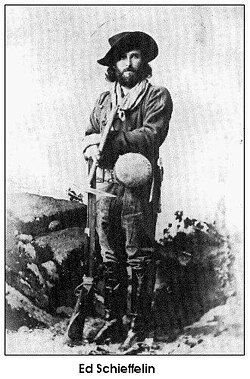
Edward Schieffelin was born October 8, 1847, in Tioga County, Pennsylvania, the oldest living child of ten. His father Clinton went west for the California Gold Rush and eventually settled the family on a claim near Woodville, Oregon. From the beginning, Ed found farming "intolerably dull." Around age ten he spent a day and a half panning a stream and produced a teaspoon of mica. His uncle, the experienced prospector Joseph Walker, found the boy's efforts amusing and informed him gently that he had spent the day collecting fool's gold. Ed was undeterred. At twelve he tried to run off to the Salmon River strike in Idaho; a neighbor talked him back. At sixteen he left home for good.
What followed was twelve years of near-total failure. He prospected across Nevada, California, Idaho, and Arizona, working wage jobs when he had to and returning to the hills whenever he could save enough to outfit himself. A man named David Lansing encountered him in 1876 and left a vivid description: "About the queerest specimen of human flesh I ever saw. He was 6 feet 2 inches and had black hair that hung several inches below his shoulders and a beard that had not been trimmed or combed for so long a time that it was a mass of unkempt knots and mats... I have never known a prospector more confident of finding a big mining proposition than he was, yet he told me that he has prospected a good part of eleven years with no results, while he had a frightfully tough time of it. He was then 27 but looked like 40."
By early 1877 he was in San Bernardino, having spent the previous fourteen months driving a wagon to rebuild his grubstake. He outfitted with $25 to $30 and two mules and headed toward the Hualapai country in Mohave County. Two months later, with nothing to show for it, he attached himself to a company of Hualapai Indian scouts heading south. That decision changed everything.
Coming to Tombstone
The scouts were heading toward the San Pedro Valley, deep in Apache country. Every soldier Ed spoke to told him the same thing: a man prospecting alone out there would not last long. "You'll find your tombstone," they said, repeatedly. The phrase was not a single dramatic prophecy from any one man. It was a running joke at the prospector's expense. Ed heard it often enough that when he made his first claim in the hills east of the San Pedro, he named it the Tombstone.
Using Fort Huachuca as his base, Schieffelin made short prospecting trips throughout the summer of 1877. The ledges in those hills were deceptive: they did not crop boldly from the ground, and the Apache threat made extended stays dangerous. He found good ore samples but not the principal deposits. By fall he was in dire straits: almost without provisions, nearly without clothing, and with thirty cents to his name. He decided to find his brother Albert, who was working at a mine in Mohave County, and persuade him to join the venture.
The journey to find Al took Ed 500 miles across rough country with unshod mules and no money. He stopped at a mine in Pinal County and worked fourteen nights operating a windlass at $3 a day, standing in the open without shelter, until he had enough to shoe the mules and buy provisions. When he finally reached Al at the McCracken Mine, he also met Richard Gird, the mine's assayer. Al showed Gird one of Ed's ore samples without revealing where it came from. Gird's reaction was immediate: "the best thing you can do is find out where that ore came from and take me with you." One piece assayed at $600 per ton. A second, from a claim Ed called the Graveyard, went $2,000 per ton on Gird's cupel.
Gird wanted to wait for spring. Ed refused. "I won't wait until spring; you may, but I shall go now." They compromised on leaving immediately, with two weeks for Gird to settle his affairs. On February 14, 1878, at noon, as the whistle blew at the mine, the three men set out: Gird and Schieffelin on a wagon, Al on horseback. Ed had been waiting long enough. They stopped in Tucson, where a merchant named Vosburg grubstaked them with $300 in supplies. They made their base camp at the abandoned Brunckow Mine adobe. Gird built an assay furnace in one of the fireplaces within a day of arrival.
The Discoveries
In the spring of 1878, the mines came in rapid succession. The first claim after their arrival, the Ground Hog, was located February 27. On March 15 Ed traced a fragment of ore no larger than a hen's egg — assaying $5,000 per ton — back to its source. The croppings were six to seven inches wide, forty to fifty feet long, and so hard you could "print a half-dollar into it." He named the claim the Lucky Cuss. It assayed $15,000 per ton, with $12,000 to $15,000 of that in silver. "There was a change over us all from that moment," Ed recalled. A week later, following the Lucky Cuss ledge northwest, he found the Tough Nut. The Good Enough was located March 25, the claim that would eventually give the Good Enough Silver Mine its name.
The venture had nearly collapsed before any of those discoveries were made. Early in the prospecting, the team's mules vanished overnight. All three men assumed Apache raiders. Gird considered abandoning the enterprise. Ed rode out for the day to give him time to reconsider, telling himself he would continue no matter what. The mules had simply wandered, their tracks leading down across the San Pedro and off toward Tucson. He recovered them twelve miles away. "There was now nothing more said about going away."
The Grand Central came last, and its discovery caused the only real friction in the partnership. A man named Hank Williams, who had been camping with them, found it first and in violation of his agreement with the group to make joint locations. They confronted him; he cut fifty to one hundred feet off one end of the claim for them. From the argument, they named their piece the Contention.
All seventeen claims were held quiet and not officially recorded until April 9, 1878, to keep the find secret as long as possible. The Tombstone Mining District was formally organized April 5, 1878. Word got out anyway. By summer, the rush was on.
From Prospector to Millionaire
The business of turning a mining claim into a functioning operation suited Ed poorly. Once the stamp mill was running, he was responsible for supervising the mining of ore, and he hated it. Gird quietly reassigned the work, and Ed went off prospecting to New Mexico and Colorado. He was constitutionally a finder, not a manager.
A Tombstone diarist named George Parsons caught a glimpse of him during this restless period. Parsons arrived in Tombstone in February 1880 and recorded a single line about the man who had started it all: "Saw Schieffelin, original discoverer of Tombstone, today. Rough looking customer." The note matches every other physical description, the long beard and battered prospector's clothing unchanged by sudden wealth.
By early 1880 Al had been negotiating with a group of Philadelphia investors. On March 14, 1880, the Schieffelin brothers agreed to sell their combined interests for $600,000. Gird did not sell at the time but eventually received the same amount for his share. In a remarkable gesture, Gird voluntarily divided roughly $132,000 of his excess proceeds equally between Ed and Al, judging that the brothers had contributed as much as he had to the venture. Ed's total proceeds from Tombstone came to approximately $385,000.
The first thing he did with the money was take care of his family. He purchased a home in Los Angeles for his parents for $80,000 and later bought a ranch in Oregon for three of his brothers. The June 1879 drive to Tucson with the first silver bars had been a proud moment: eight bars worth $18,744.50, hauled in the same blue spring wagon they had used to come to Tombstone, displayed at the Safford, Hudson & Company bank.
By that summer Schieffelin was a wealthy man with little to do. Parsons noted him at a variety show: a dancer named Patte Rosa "danced well. Ed Schieffelin seems to be badly gone on her." It was a different kind of prospecting.
After Tombstone
Ed left Tombstone before the town had fully taken shape and spent the rest of his life prospecting. In the spring of 1882, he and his younger brother Effingham outfitted a fifteen-ton stern-wheeler in San Francisco and sailed for Alaska. Their party of five reached the Yukon River trading post at Nuklukayet in late August, found some coarse gold in October, and prospected through the following summer before the enterprise broke up. Ed sold the boat and returned to California, concluding that Alaska was "inhabitable" and its gold deposits not extensive.
In late 1883 he married Mrs. Mary E. Brown in La Junta, Colorado. They had met in Albuquerque and settled eventually in Alameda, California. His father Clinton died in 1884 from an accidental gunshot wound in Los Angeles (a later secondary source, Cochise County Stalwarts, instead describes the death as a suicide by revolver; the two accounts have not been reconciled). His brother Al died of tuberculosis in 1885. For the decade that followed, the documentary record is thin. A reporter who interviewed Ed on a train in 1886 noted his "full appreciation for the luxuries of life." A Bancroft Library representative who interviewed him around the same time described "a man of large and powerful build... bronzed face and flowing brown hair and beard... clear blue eyes... 5 feet 11 and a half inches tall." A companion from an 1884 prospecting trip in the Papago country offered a different view: Ed showed "a disinclination to visit any discovery in which he was not the actual participant" and "never brought into camp a mineral bearing specimen" during their time together. The man who found Tombstone, it seemed, was always looking for the next one.
Death and the Red Blanket Legend
In 1895, at age 47, Ed outfitted in Portland and headed south through Oregon prospecting country he had known since boyhood. He hired a camp helper named Charley Warren, and the two worked through eastern Oregon, Nevada, and northern California for a year and a half. In early 1897 Ed settled near a creek in Douglas County, Oregon, boarding his wagon and team at a local farm and working out of an empty cabin near the confluence of Days Creek and Moore Creek. Placer gold had come from those creeks since 1859. He was looking for the mother lode that fed the placers, a prospect he had described in his 1886 Bancroft interview.
When he failed to make an appointed supply call, the farmer George Jackson went looking for him. He found Ed's body on the cabin steps, near his gold pan, apparently having died while assaying the day's work. The official death date, from the coroner's inquest, was May 12, 1897. He was 49 years old.
Per his own instructions, Ed was buried in prospector's garb with his old pick and canteen, on top of a granite hill three miles northwest of Tombstone near the site of his first camp. A monument of cemented rock, twenty-five feet high in the shape of a prospector's claim marker, was placed over the grave. Its inscription reads: "Ed Schieffelin / Died May 12, 1897 / Aged 49 years / 8 months / A Dutiful Son / A Faithful Husband / A Kind Brother / A True Friend."
Around his death grew the legend of the Red Blanket Mine. The story holds that Ed kept a diary in his final days and that the last entry read "a prospect at last," and that because he customarily carried a red blanket on overnight trips and no red blanket was found in the cabin, he must have used it to mark the site of a rich gold find before he died. Searchers have combed the Days Creek area ever since, digging so many prospect holes that the area is now hazardous to walk.
The evidence for the legend is thin. Charley Warren, the last man to prospect with Ed, stated flatly that Ed had no red blanket. The only written source for the "prospect at last" entry is a single letter from Mrs. Schieffelin to a local searcher, written in her own hand, in 1900. The brothers who went to retrieve Ed's body found nothing. A geologist familiar with the area noted that the type of gold-bearing quartz reportedly found with Ed could not have come from the Coffee Creek placer beds. Ed's total worth at death was approximately $75,000 — not the estate of a man who had just found another bonanza. The historian who researched the legend most thoroughly concluded that the diary probably never existed, and wondered whether Ed, with his lifelong sense of irony, might have contrived the whole thing as a final joke on the world that had laughed at him for so long.
Sources
- Lonnie E. Underhill, ed., "The Tombstone Discovery: The Recollections of Ed Schieffelin and Richard Gird," Arizona and the West, vol. 21, no. 1 (Spring 1979), pp. 37–76.
- James E. Moore, "The Silver King: Ed Schieffelin, Prospector," Oregon Historical Quarterly, vol. 87, no. 4 (Winter 1986), pp. 367–387.
- Herbert Love, History of Tombstone to 1887 (1933).
- George W. Parsons, The Private Journal of George Whitwell Parsons, vol. 1 (1880–1882). Source for: first meeting ("Rough looking customer," February 1880); variety show observation (summer 1880).
- Lynn R. Bailey and Don Chaput, Cochise County Stalwarts: A Who's Who of the Territorial Years, vol. 2, pp. 98–100. [Source for the conflicting account of Clinton Schieffelin's death.]
Location
The Schieffelin Monument stands on a granite hill approximately three miles northwest of Tombstone on Allen Street extended. It is a twenty-five-foot cemented rock cairn in the shape of a prospector's claim marker and is listed on the National Register of Historic Places. The surrounding hills offer a clear view of the mountain ranges Ed would have seen when he first camped in this country.